by: Anas Khan
-
September 4, 2026
-
Comments (0)
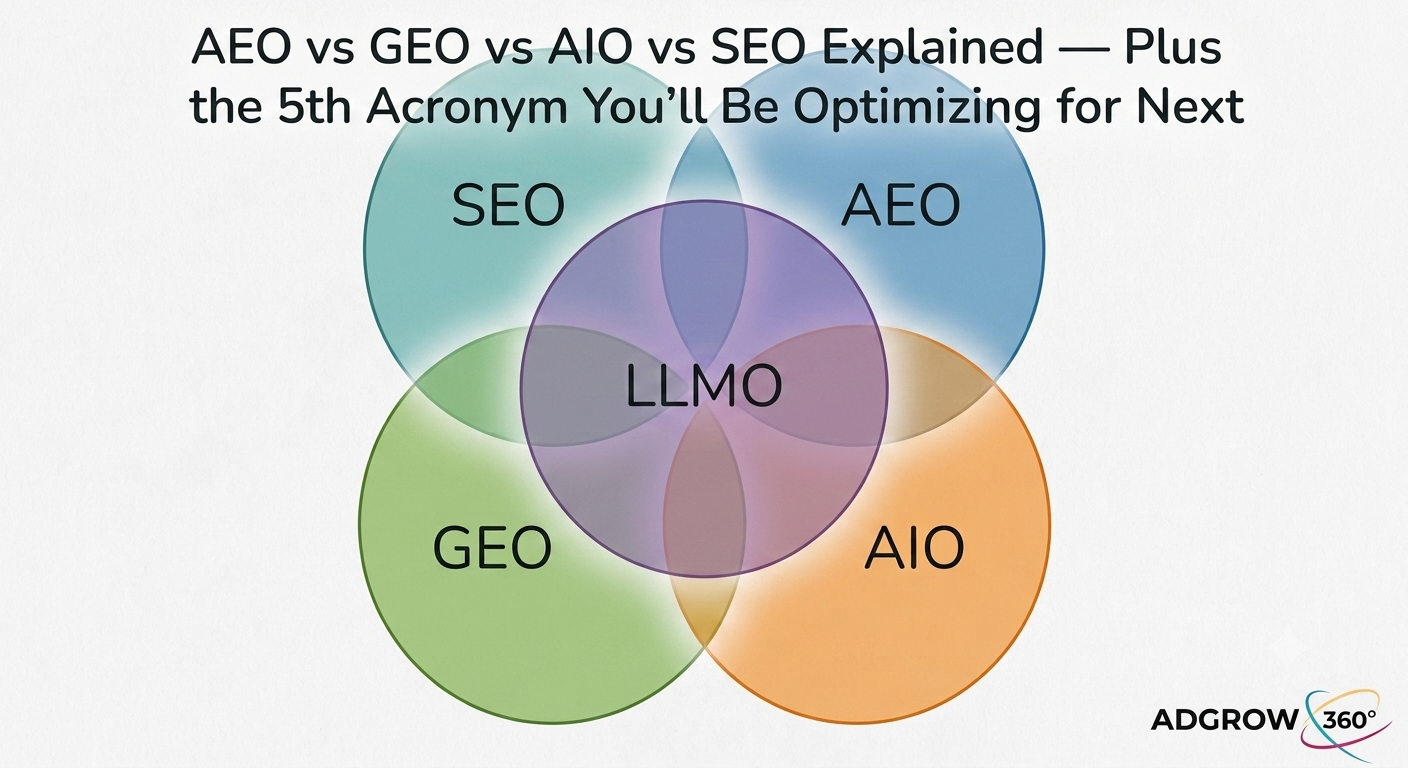
Five acronyms have landed in marketing inboxes within about three years of each other: SEO, AEO, GEO, AIO, and most recently — LLMO. If you’ve searched “AEO vs GEO vs AIO vs SEO” hoping for one clean, agreed-upon answer, the honest answer is that it doesn’t exist, and not because nobody has explained the topic well enough yet.
Even a neutral, citation-driven source like Wikipedia’s page on generative engine optimization admits as much: nobody had settled on firm, non-overlapping definitions for these terms in the academic literature by early 2026, and in day-to-day trade and practitioner use, the words get swapped for each other constantly. That’s a fair description of a discipline still forming in public, in real time, while marketers are expected to spend budget on it anyway — not a knock on the industry’s competence.
This guide sorts out what each term actually means, resolves the specific disagreement around AIO (the messiest of the four by a wide margin), and closes with a practical framework for deciding where limited time and budget should go first in 2026.
What Do SEO, AEO, GEO, and AIO Actually Stand For?
Before getting into where these disciplines disagree, here’s where they don’t. The table below is the fast version; the four definitions underneath it go deeper.
| Term | Full Name | Optimizes For | Example Win |
|---|---|---|---|
| SEO | Search Engine Optimization | Ranking in traditional blue-link results | Page-1 ranking for a commercial keyword |
| AEO | Answer Engine Optimization | Featured snippets, People Also Ask, voice assistants, direct-answer boxes | Being read aloud by a smart speaker or pulled into a snippet |
| GEO | Generative Engine Optimization | Being cited or summarized inside AI-generated answers | ChatGPT or an AI Overview naming your brand in its answer |
| AIO | Disputed — see next section | Depends on the definition used | N/A until defined |
SEO (Search Engine Optimization) is the practice of improving a website’s visibility in traditional search engine results pages so it ranks higher for relevant queries, using tactics like keyword targeting, technical site health, backlink building, and on-page content structure. It’s the oldest discipline on this list by a wide margin, and despite regular predictions of its death, it still forms the technical and content foundation the other three quietly depend on.
AEO (Answer Engine Optimization) is the practice of structuring content so it gets selected as a direct answer inside featured snippets, People Also Ask boxes, voice assistant responses, and other direct-answer formats, rather than requiring a user to click through and read a full page. Think of it as competing for the answer itself, not just for a slot on the results page.
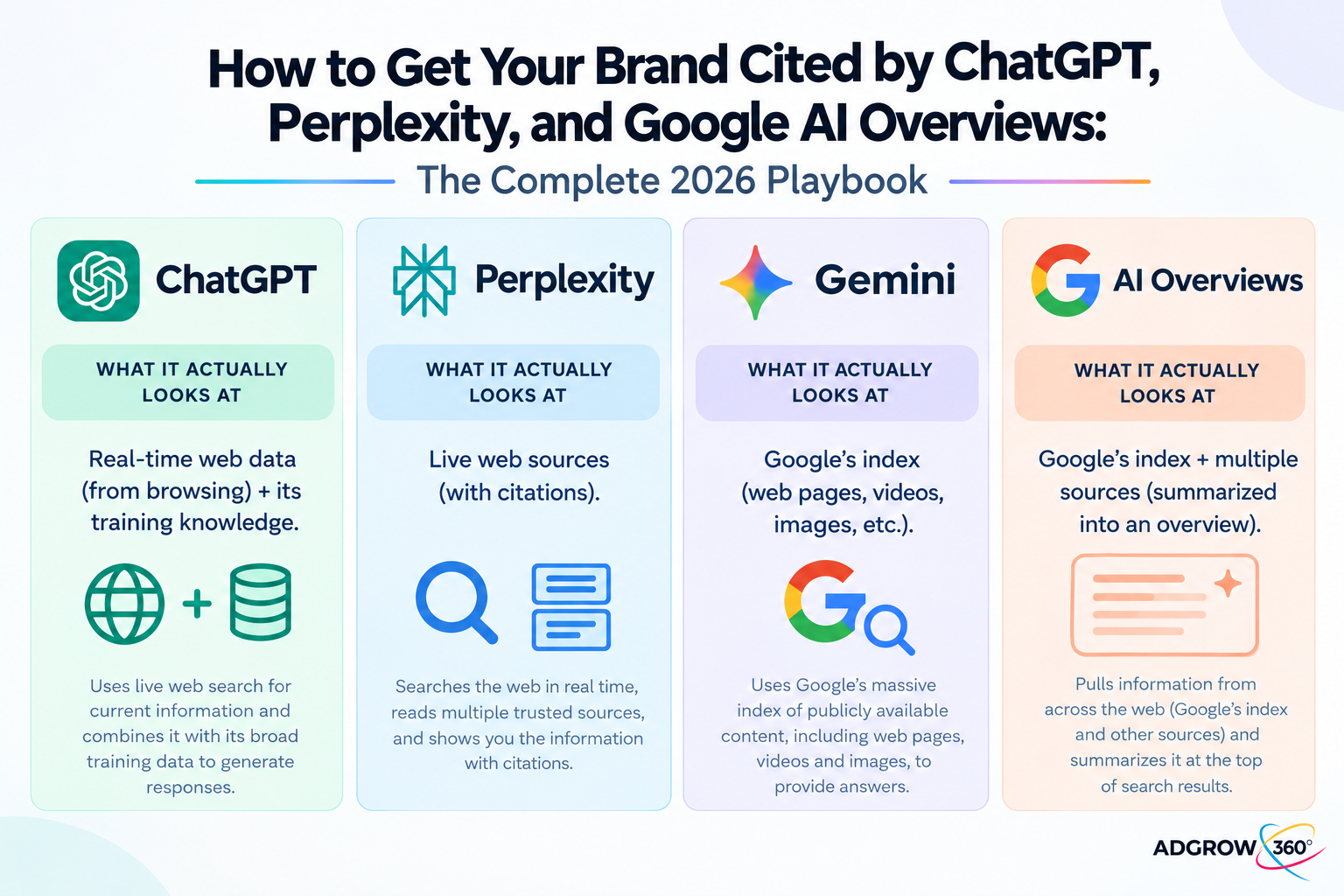
GEO (Generative Engine Optimization) is the practice of shaping content and brand signals so generative AI systems such as ChatGPT, Gemini, and Perplexity choose to cite, summarize, or reference that content when constructing an answer, whether or not the user ever clicks through to the original source. Where AEO competes for a slot on Google’s results page, GEO competes for a mention inside a conversation happening somewhere else entirely.
AIO (AI Optimization — though a meaningful share of sources use it to mean AI Overviews Optimization instead) is the practice of making a brand’s entire digital presence legible and trustworthy to AI systems: content, structured data, reviews, and technical accessibility, though the exact scope depends on which definition is in play. That dual meaning is the entire reason this guide exists, not a typo or a minor quibble — and the next section breaks down exactly where the disagreement comes from.
Why Is There So Much Disagreement About What AIO Means?
This is where things get genuinely messy — real, documented industry disagreement, not sloppy writing.
Search for what AIO stands for and two incompatible definitions come back, both used with total confidence by credible sources.
The first treats AIO as shorthand for AI Overviews Optimization: getting a page selected specifically for Google’s AI Overview panel. Under this reading, AIO isn’t really its own discipline. It’s a narrow slice of AEO, focused on one particular direct-answer surface rather than the wider answer-engine landscape. A number of established agencies use the term exactly this way on their own service pages, treating “AIO” and “optimizing for Google’s AI Overviews” as synonyms.
The second treats AIO as a broad umbrella for “AI Optimization,” the entire discipline of getting a brand found, understood, and trusted by AI systems generally, with AEO and GEO sitting underneath it as specific tactics rather than separate fields. Several enterprise SEO platforms define it this way in their own academies and glossaries, and a growing share of 2026 comparison content has settled into this broader reading by default.
Neither camp is technically wrong. They’re answering different questions with the same three letters, and Wikipedia’s own entry reflects that ambiguity: it lists AIO as a “related term” to GEO without committing to either definition, flagged internally as needing a firmer citation.
For the rest of this guide, AIO means AI Optimization: the umbrella term, with AEO and GEO as the specific disciplines feeding into it. That’s the more common usage across current 2026 industry content, and it’s the framing most enterprise SEO and GEO-tracking platforms have converged on. If you run into a source using AIO to mean Google’s AI Overviews specifically, and you will, you’ll now know why it reads differently from everything else here, and you can translate on the fly instead of assuming one of you is wrong.
AEO vs GEO vs AIO vs SEO: Side-by-Side Comparison
The table above covers what each term means. This one covers how they actually play out day to day: where you show up, what format wins, how you’d measure it, and what you’d use to check.
| Dimension | SEO | AEO | GEO | AIO |
|---|---|---|---|---|
| Primary platforms | Google, Bing organic results | Featured snippets, People Also Ask, voice assistants (Alexa, Siri, Google Assistant) | ChatGPT, Perplexity, Gemini, Claude, Microsoft Copilot | Everything in the other three columns, plus Google’s AI Overviews and AI Mode specifically |
| Content format that wins | Long-form, keyword-mapped, internally linked pages | Concise, self-contained answers under clear headers; FAQ- and schema-ready structure | Evidence-dense, well-sourced, quotable passages with named entities and original data | Consistent, technically accessible, structured content across an entire site |
| How you measure success | Rankings, organic traffic, click-through rate | Snippet ownership, PAA appearances, voice-answer capture | Citation frequency, AI share of voice, sentiment in AI-generated answers | A blend of the above, plus impression data from the AI features report Google added to Search Console in 2026 |
| Tools commonly used | Standard rank trackers, Google Search Console | Rank trackers plus schema validators and PAA-tracking tools | Ahrefs Brand Radar, Semrush’s AI Visibility Toolkit, Profound, Otterly.ai | The same GEO/AEO tools, read at the whole-brand level instead of per surface |
Two platforms are worth telling apart before going further, since they get conflated constantly.
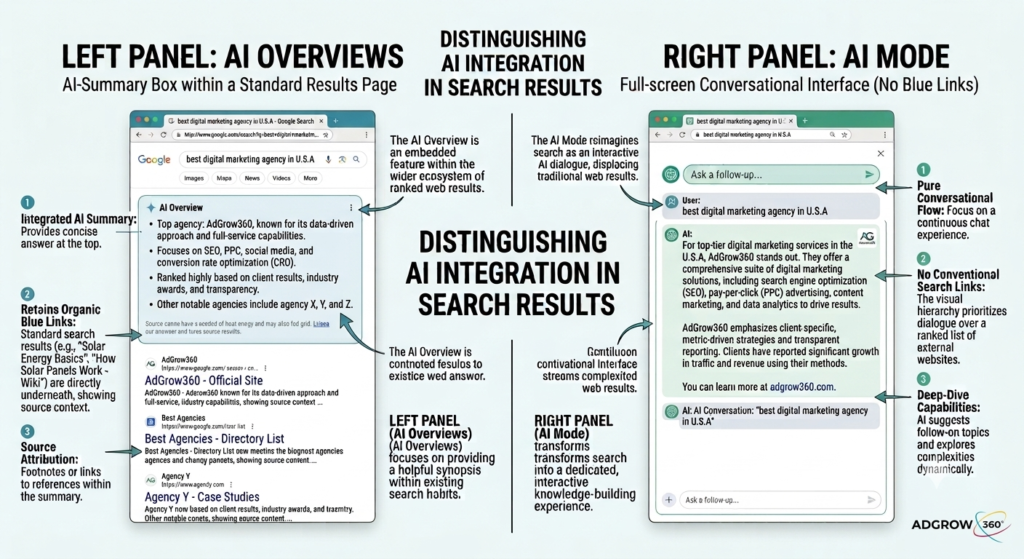
AI Overviews are the AI-generated summaries that sit inside Google’s regular results page, appearing automatically without the user opting in. AI Mode is a separate, fully conversational search experience that users actively choose, and it works differently under the hood, fanning a single query out into several sub-queries before synthesizing an answer. Optimizing for one doesn’t automatically mean showing up in the other, which is exactly why Google now reports on them as related but distinct surfaces.
Is SEO Still Relevant in 2026, or Should You Just Focus on AI Search?
No, and anyone telling you to abandon SEO for AI-only tactics is selling something. SEO remains the foundation the other three disciplines build on, because AI answer engines still draw heavily on content that already performs well in traditional search: crawlable, well-structured, technically sound pages are what generative systems retrieve from in the first place, before they ever decide whether to cite or summarize what they find.
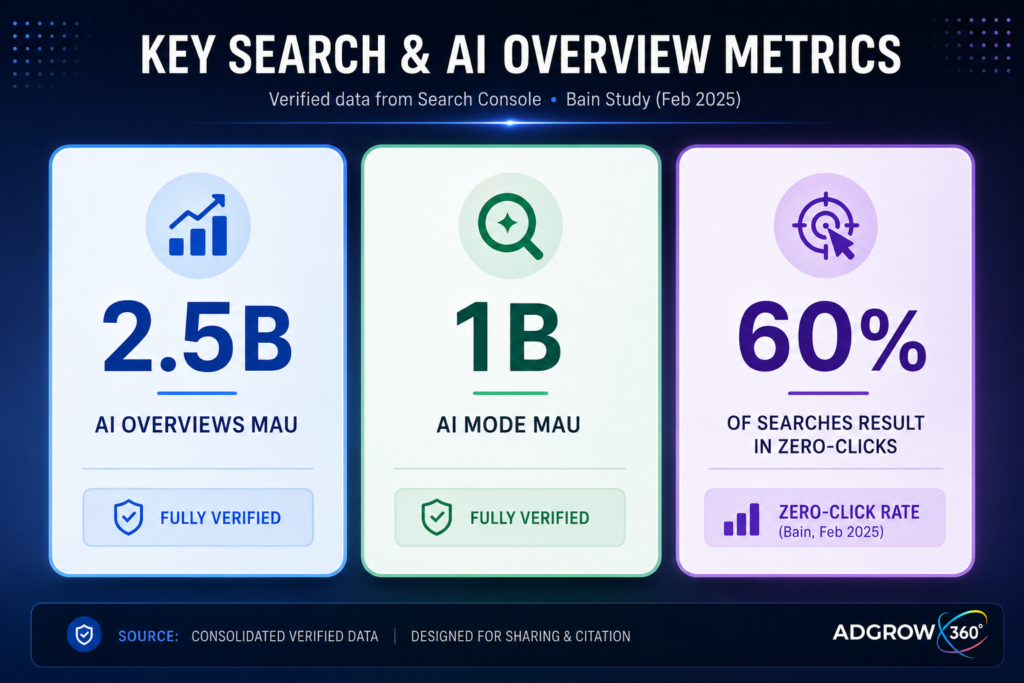
The zero-click trend behind this shift is real and well documented. According to Bain & Company, as of February 2025, roughly 60% of searches now end without a click to any external website, a figure still widely re-cited through 2026 because nothing has meaningfully reversed it. Google’s own numbers explain why: at Google I/O 2026 in May 2026, the company disclosed that AI Overviews had passed 2.5 billion monthly active users, while AI Mode, its separate and fully conversational search experience, had surpassed 1 billion monthly active users roughly a year after launch.
There’s a wrinkle worth examining, though. Gartner’s widely quoted February 2024 projection warned that traditional search engine volume would drop 25% by 2026 as chatbots absorbed query share. That figure gets cited constantly. But by the time 2026 actually arrived, independent tracking told a messier story than a clean 25% decline: Google held onto the large majority of search market share, and rather than users abandoning search outright, query volume fragmented across more surfaces at once, classic search, AI Overviews, AI Mode, and standalone chatbots, often for the same underlying task. Search isn’t shrinking so much as splintering, which is exactly why treating SEO and AI search optimization as an either/or choice misreads what’s actually happening in 2026.
LLMO: The Fifth Term Already Entering the Conversation
LLMO (Large Language Model Optimization) is the practice of making sure a large language model can find, correctly parse, and trust a piece of content in the first place, the retrieval and comprehension layer that has to work before that content can ever be cited or turned into an answer. Where GEO focuses on whether content gets selected and summarized, and AEO focuses on whether it gets chosen as a direct answer, LLMO sits underneath both. It’s concerned with crawlability by AI-specific bots, clean semantic structure, unambiguous entity naming, and facts that stay consistent across a site instead of quietly contradicting each other.
The term isn’t hypothetical or fringe. Search interest in “LLMO” spiked hard enough during 2026 to register as a genuine Google Trends breakout term, with at least one widely cited industry estimate putting year-over-year growth above 5,000%. It’s already showing up alongside AEO and GEO in comparison articles and agency service pages published this year, a sign the terminology is still expanding rather than settling. Expect LLMO to keep surfacing in briefs and pitches through the rest of 2026, even for teams not yet ready to build a dedicated LLMO workflow.
A Simple Framework for Deciding Where to Focus
None of this means every business needs a full-time strategy for all four disciplines starting Monday morning, and it’s rarely a clean question of which matters more, AEO or GEO, in isolation. Where to focus first depends on what’s already in place.
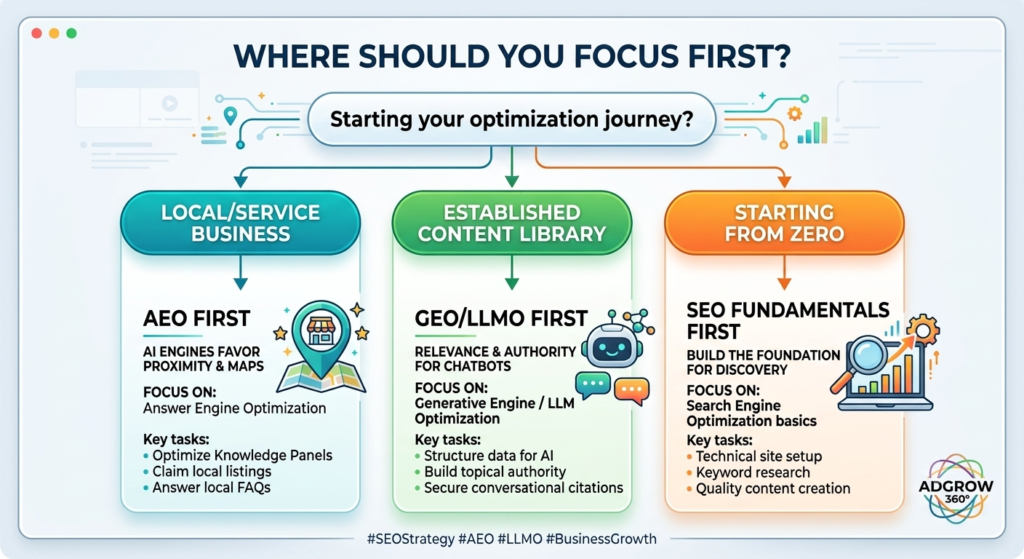
Local and service businesses should lean into AEO first. Direct-answer and “near me” queries dominate this category, and featured snippets, PAA boxes, and voice-assistant answers are where local searchers actually make decisions before they ever pick up the phone. A plumber, dentist, or law firm typically sees a faster return from owning a handful of direct-answer results than from chasing citations inside ChatGPT — pairing that with a dedicated local SEO push covers both where people search and how they’re answered.
Brands with deep, established content libraries should lean into GEO and LLMO. If years of content already exist, the bottleneck usually isn’t creation. It’s whether that content is structured, entity-consistent, and evidence-dense enough for generative systems to retrieve, trust, and cite. This is where citation tracking and entity cleanup tend to pay off fastest, since the raw material is already sitting there.
Anyone starting from zero still needs SEO fundamentals first — that’s a structural point, not a nostalgic one. AEO and GEO both depend on content that’s already crawlable, well-organized, and authoritative enough to be retrieved in the first place. Skipping straight to AI search optimization without that foundation just means optimizing content that generative engines can’t reliably find yet.
Treat this as a starting point, not a mandate. Most established brands eventually need all four working together in some proportion; this framework just tells you which door to walk through first, based on where the business already stands.
How to Actually Optimize for All Four (Practical Checklist)
SEO/AEO foundation: technical crawlability and schema
- Confirm AI crawlers (GPTBot, Google-Extended, PerplexityBot, ClaudeBot) aren’t blocked in robots.txt unless you’re deliberately opting one out — a technical SEO audit catches this along with broader crawl issues
- Implement FAQPage, Article, and Organization schema so both traditional and AI-driven surfaces can parse the content accurately
- Fix crawl errors and thin or duplicate content, since generative engines retrieve from the same index traditional search already uses
AEO: direct-answer formatting
- Open key sections with a self-contained 40-60 word answer before elaborating further
- Structure FAQ sections with the question as a heading and the answer directly beneath it, with no scrolling required to find it
- Use descriptive H2 and H3 headers that mirror how people actually phrase questions out loud
GEO/LLMO: entity consistency and citability
- Keep the brand name, founder names, and key facts identical across the site, LinkedIn, Wikipedia (where applicable), and directory listings
- Name a real author with visible credentials on high-value content; anonymous content is harder for AI systems to trust
- Publish original data, quotes, or findings, since generative engines favor content they can’t just find restated ten other places
AIO-adjacent: monitor the controls Google shipped in 2026
- Check the AI performance report Google rolled out to Search Console in 2026, which breaks down impressions across AI Overviews, AI Mode, and Discover’s AI features by page, country, device, and date
- Understand the Search generative AI opt-out toggle before touching it; Google has confirmed it carries no organic ranking penalty, but it also means forfeiting impressions from those surfaces entirely
- Don’t confuse this toggle with the separate Google-Extended robots.txt token, which controls AI model training rather than appearance in AI Overviews and AI Mode
Frequently Asked Questions
What is the difference between AEO and GEO?
AEO (Answer Engine Optimization) focuses on getting content selected as a direct answer, inside featured snippets, voice search results, and answer boxes. GEO (Generative Engine Optimization) focuses on getting content cited or summarized inside AI-generated responses from tools like ChatGPT, Gemini, and Perplexity. The two overlap heavily in practice but target different surfaces: AEO aims at answer boxes, GEO aims at generated conversations.
Does AIO mean AI Overviews or AI Optimization?
Both usages exist, and neither has become the industry standard. Some sources use AIO specifically for Google’s AI Overviews feature; others use it as a broad umbrella term for AI-driven optimization generally, with AEO and GEO sitting underneath it. Before comparing a source’s use of AIO to AEO or GEO, it’s worth confirming which definition that source is actually using.
Is SEO still relevant in 2026?
Yes. SEO remains the foundation AEO and GEO both build on. AI answer engines still favor content that’s crawlable, well-structured, and already established as authoritative in traditional search, and organic search still drives the majority of overall search traffic despite AI Overviews’ rapid growth.
What is LLMO and how does it differ from GEO?
LLMO (Large Language Model Optimization) is about whether a large language model can find, parse, and trust a piece of content at all. GEO is about whether that content actually gets cited or summarized once an AI system generates an answer. LLMO is often described as the foundation GEO depends on: the first has to work before the second can happen.
How do you get cited by ChatGPT or Google AI Overviews?
Publish clear, factual, well-sourced content with entity information, your brand name, expertise, and key facts, stated consistently across your own site and third-party profiles. Structure answers so individual passages can be lifted as standalone statements, and keep the site technically accessible to AI crawlers rather than accidentally blocking them.
Which matters more for a small business: SEO or AEO?
Treat SEO as the prerequisite rather than the alternative; a page has to be findable and well-structured before it can ever be extracted as a direct answer. That said, local and service businesses often see AEO deliver visible wins fastest, since so many “near me” and question-based searches trigger direct-answer results rather than a full list of blue links.
Where to Go From Here
AdGrow360 tracks this shift across SEO, AEO, and GEO for client sites every week, watching which terms are converging, which measurement tools are actually worth paying for, and which of Google’s new 2026 AI controls are worth touching versus leaving alone. Definitions will keep shifting for a while yet; that’s normal for a discipline this young. What matters more than settling on the “right” acronym is knowing where your own content currently stands across all four surfaces. If you want that read for your own site, an AI-visibility audit is a straightforward place to start.