by: Anas Khan
-
October 29, 2026
-
Comments (0)
Before you sign with any AI SEO agency, get four answers. What will they change on your site in the first 30 days? How will they measure where you show up in ChatGPT, Gemini, Claude, Perplexity and Google AI Overviews? Who will actually do the work? And who owns your accounts and data? If anyone guarantees rankings or AI citations, walk away.
Everybody calls themselves an AI SEO agency now. Some rebuilt the way they work around how AI engines pick their sources. Plenty just changed the name on the old SEO retainer. You can’t tell which is which from a homepage, and a wrong pick costs you months, not just a few invoices.
So here’s what we’d ask if we were the buyer: 12 questions for the first call (with what a good answer and a bad one sound like), 9 red flags you can check yourself, a scorecard for comparing proposals, and a quick test you can run in half an hour before you sign anything.
Full disclosure: we’re AdGrow360, an India-based digital marketing agency working with US clients, and we sell AI search optimization ourselves. So take our advice with that in mind. We’ve tried to write the guide we’d want a buyer to hold us to, and our own test results are further down, including the ones that don’t flatter us.
Key takeaways
- “AI SEO” is really three different services. Find out which one is in the proposal.
- Judge an agency on its method, a dated baseline and how honest it is about limits. One lucky screenshot proves nothing.
- Nobody controls what ChatGPT or Gemini says. If someone promises you a spot, they’re guessing or selling.
- Get the first month in writing, plus exclusions, short exit terms and ownership of your data.
- Check for red flags first. Only then compare scores.
What does an AI SEO agency actually do?
A good AI SEO agency makes your site easy for AI engines to reach, read and trust, then shows you proof that it worked. Google’s own guidance says optimizing for its generative AI features is still SEO, and you don’t need special markup or files for it. So most of the work is solid SEO fundamentals, plus testing across several AI engines instead of just Google.
The trouble is that “AI SEO” gets used for three very different things. Ask which one you’re being sold before you compare prices.
Meaning | What it is | Risk |
|---|---|---|
Traditional SEO delivered with AI tools | The agency uses AI to draft, cluster keywords and summarise audits. | Says nothing about whether AI engines will cite you. Quality depends on human review. |
AI search optimization (AEO / GEO) | Work to get your brand named and cited in ChatGPT, Gemini, Claude, Perplexity, Copilot and Google AI Overviews. | The service most buyers actually want. Measurement is imperfect and results vary. |
AI-generated content at volume | Hundreds of model-written pages published on your domain. | Highest risk. Google’s spam policies treat mass-produced pages made mainly to manipulate rankings as scaled content abuse. |
AEO (answer engine optimization) and GEO (generative engine optimization) are the usual names for the second one. You’ll also run into LLMO and plain “AI search optimization”. They overlap a lot, so look at the scope of work, not the label. We break down the differences in our AEO vs GEO vs AIO vs SEO guide.
Why ranking in Google isn't enough
You’d think a page that ranks well in Google would get picked up by ChatGPT or Gemini too. Mostly it doesn’t. An Ahrefs study of 15,000 long-tail queries found that only about 12% of the links cited by ChatGPT, Gemini and Copilot showed up in Google’s top 10 for the same prompt. Perplexity did best, at 28.6%. That gap is the real reason to hire for AI visibility, and it’s why an ordinary SEO retainer may not cover it.
What an AI SEO engagement should actually include
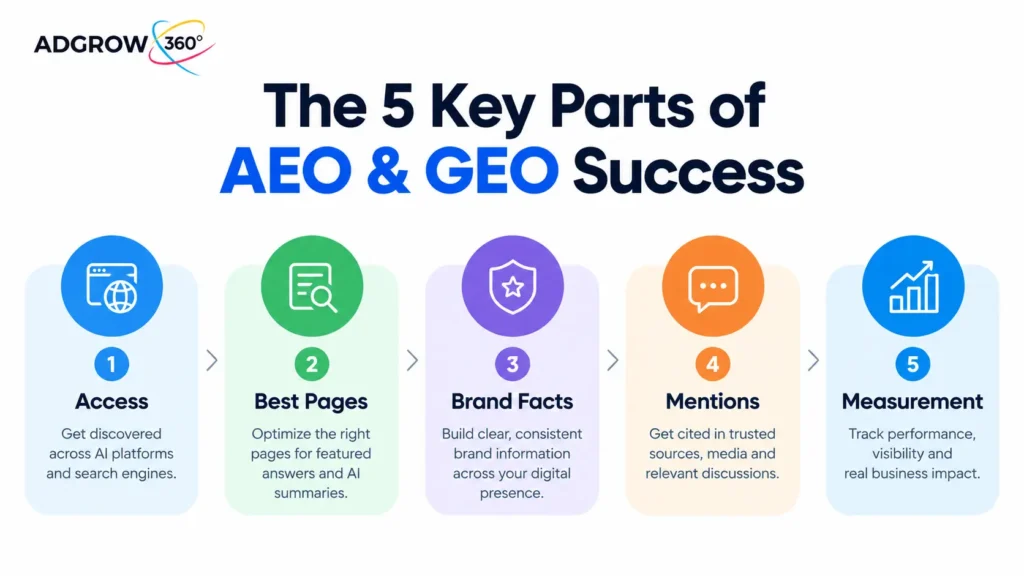
- Access. Can AI crawlers like GPTBot, OAI-SearchBot, ClaudeBot and PerplexityBot get to your pages? That means robots.txt, CDN rules, indexing and snippet settings.
- Your best pages. Rework the pages that already get impressions or answer real buyer questions. Lead with the answer, and back claims with sources.
- Brand facts. Keep the same company name, offer, location and pricing across your site and profiles, so AI engines stop contradicting themselves.
- Mentions. Earn real mentions on the sources AI engines read: reviews, industry sites, forums and video.
- Measurement. Search Console, Bing Webmaster Tools, GA4 and your CRM, plus a fixed set of prompts you track over time.
If a proposal puts most of its budget somewhere else, ask why.
12 questions to ask an AI SEO agency before you sign
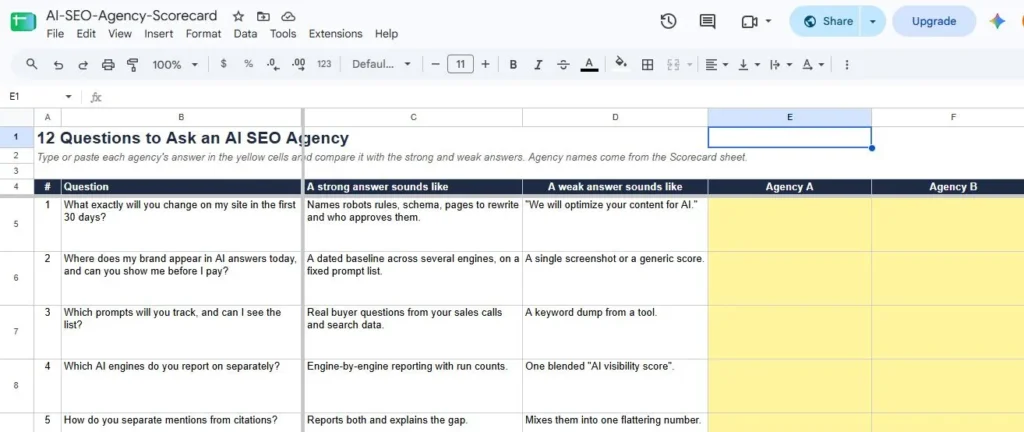
Ask these on the first call and write down what you hear. The specifics matter more than how confident the answer sounds. A good agency talks about pages, files, dates and numbers.
# | Question | Why it matters | Strong answer | Weak answer |
|---|---|---|---|---|
1 | What exactly will you change on my site in the first 30 days? | Separates a real plan from a slogan. | Names robots rules, schema, pages to rewrite and who approves them. | “We will optimize your content for AI.” |
2 | Where does my brand appear in AI answers today, and can you show me before I pay? | You need a baseline to judge any later result. | A dated baseline across several engines, on a fixed prompt list. | A single screenshot or a generic score. |
3 | Which prompts will you track, and can I see the list? | The prompt list decides what gets measured. | Real buyer questions from your sales calls and search data. | A keyword dump from a tool. |
4 | Which AI engines do you report on separately? | ChatGPT, Gemini, Claude, Perplexity and AI Overviews cite different sources. | Engine-by-engine reporting with run counts. | One blended “AI visibility score”. |
5 | How do you separate mentions from citations? | Being named and being linked are different outcomes. | Reports both and explains the gap. | Mixes them into one flattering number. |
6 | Which of your methods come from Google, Bing or OpenAI documentation, and which are your own testing? | Shows honesty about what is proven. | Labels opinions and experiments as such, and names sources. | “Our proprietary GEO framework.” |
7 | Who will do the work, and can I meet them? | Pitch teams and delivery teams often differ. | A named person who stays on the account. | “Our content team will handle it.” |
8 | How do you use AI in your own workflow, and who reviews the output? | AI-written pages without expert review rarely earn citations. | AI for research and drafts, with a named human editor and fact check. | Volume targets and no review step. |
9 | How do you earn mentions off my site? | AI engines lean on third-party sources. | Names the types of sources and the approach. | A secret “network” of sites. |
10 | How will you connect AI visibility to leads or revenue? | Mentions that never reach revenue are a vanity metric. | GA4 AI referral segments, a CRM field for “how did you hear about us”, assisted conversions. | Impressions and “brand lift” only. |
11 | What will you not promise, and what happens if results stall after 90 days? | Honest agencies answer this easily. | Written exclusions, a review meeting and a plan to change course. | Guarantees, or “AI takes time, trust the process.” |
12 | Who owns the accounts, content, prompt lists and data, and what happens if I leave? | Protects you if the relationship ends. | You own everything, with short notice terms. | Agency-owned logins or long lock-ins. |
Better still, email the questions before the call. An agency that replies with numbers and dates is a safer bet than one that sounds smooth on the phone. And if two agencies give you equally polished answers, go with the one that’s willing to put specifics in writing.
Also notice whether they’re curious about you. A good agency asks about your buyers, your competitors and how customers find you before it pitches anything.
9 red flags when choosing an AI SEO agency
Walk away from an agency that guarantees rankings or AI citations, hides its method, buys mentions, or plans to publish hundreds of AI-written pages. Every red flag below goes against something Google or OpenAI has published, and you can check most of them in a few minutes.
# | Red flag | Why it is a problem | How to verify it |
|---|---|---|---|
1 | Guaranteed rankings or AI citations | Google says no one can guarantee a number one ranking, and AI answers change from run to run. | Ask for the guarantee in the contract. A refusal tells you everything. |
2 | Claims of special access to Google data, or paid placement inside ChatGPT answers | Google says no third-party tool can see its internal ranking systems. OpenAI says ads are labeled and kept separate from answers. | Ask which data source supports the claim. |
3 | Hundreds of AI-written pages as the main deliverable | Google’s spam policies target scaled content made mainly to manipulate rankings, whether written by people or AI. | Ask how many pages, who edits them, and what real question each answers. |
4 | Bought mentions, reviews or links | Google calls inauthentic mentions less helpful than they appear, and the US FTC banned fake and paid-for reviews in 2024. | Ask which kinds of sources they target and how they earn them. |
5 | A screenshot as the only proof | In a study of nearly 3,000 runs by SparkToro and Gumshoe.ai, the odds of getting the same list of brands twice were under 1 in 100. | Ask for repeated runs, dates and a share-of-runs figure. |
6 | A secret method or no written methodology | Google’s hiring guidance warns against companies that will not explain what they plan to do. | Ask for a written scope and a sample monthly report. |
7 | Senior people pitch, junior people deliver | The strategy you were sold may never reach your account. | Ask to meet the person who will run your work. |
8 | llms.txt or a “proprietary AI file” as the main lever | Google Search ignores llms.txt, and an Ahrefs analysis found most of those files get no requests. | Ask what else is in the plan. A fine extra, a weak strategy. |
9 | Agency-owned logins for your accounts and data | You lose access and history if you leave. | Make sure a person in your company is the verified owner of Search Console and analytics. |
Things that look like red flags but aren't
- They tell you some tactics are untested. Good. An agency that labels an experiment as an experiment is easier to trust than one that sells everything as proven.
- They won’t guarantee results, but they show you their method. That’s exactly what you want.
- They use AI tools internally. Fine, as long as a named expert reviews and fact-checks the output.
- They start with an audit instead of writing content. Also good. Blocked crawlers and wrong brand facts often hurt citations more than missing content does.
How to score AI SEO agency proposals
Score each proposal on 10 criteria, from 0 to 2 points each, for a maximum of 20. Sixteen or more makes the shortlist. Twelve to fifteen deserves a follow-up call. Below twelve, drop it. And any red flag from the list above knocks a proposal out, whatever its score.
# | Criterion | 0 points | 1 point | 2 points |
|---|---|---|---|---|
1 | First 30 days are named | Vague | Partly specific | Pages, files and owners listed |
2 | Dated baseline and retest plan | None | Baseline only | Baseline, fixed prompts and a retest date |
3 | Prompt list built from buyer questions | None | Keyword list | Real buyer questions you can review |
4 | Reporting by engine, with mentions and citations separate | One blended score | Partly separated | Fully separated, with run counts |
5 | Sources cited and experiments labeled | No sources | Some sources | Primary sources named, opinions labeled |
6 | People you have met | Salesperson only | Lead only | The person who will do the work |
7 | You own accounts, data and prompt lists | Agency-owned | Shared | You own everything |
8 | Written exclusions and no guarantees | Guarantees | Unclear | Exclusions in writing |
9 | Exit terms | Long lock-in | Medium | Short notice after the first phase |
10 | Reports tie to leads or revenue | Traffic only | Some attribution | GA4 and CRM linked |
A worked example (with made-up numbers)
Say a 25-person services firm gets three proposals. These numbers are invented to show how the method works. They’re not real data.
Proposal | Score | Red flag? | Decision |
|---|---|---|---|
A: 40 AI-written articles a month and a dashboard score | 6 / 20 | Yes, guarantees “top AI placement” | Out |
B: Audit of ten key pages, fixed prompts, Search Console reporting | 18 / 20 | No | Shortlist |
C: Strong industry experience but a vague first month | 13 / 20 | No | Follow-up call on questions 1, 2 and 10 |
The score isn’t magic. It just turns the gut feeling you got on a sales call into something your team can argue about with evidence.
Want the spreadsheet version? Download the scorecard here:
https://docs.google.com/spreadsheets/d/1fIBL0vtC2tASKloGmBCRvOUIHnEYMWiyGZW1BDj51qg/edit?usp=sharing
AI SEO agency vs freelancer vs in-house: which should you hire?
Hire a specialist AI SEO agency if AI answers are your main goal and you need someone doing the work every month. Hire a freelancer or consultant if your team can implement and you mainly need direction. Build in-house only if AI search is central to your growth and you can hire and keep the right people.
Option | Best when | Trade-off | Ask before hiring |
|---|---|---|---|
Specialist AI SEO (AEO / GEO) agency | AI answers are the main target and you can approve changes quickly | Check who actually does the work | Questions 1, 2 and 7 |
Traditional SEO agency adding AI | Your basics are still broken (indexing, speed, thin pages) and AI is a second phase | AI work may be a rebranded retainer | Questions 4, 5 and 6 |
Freelancer or consultant | You have a team to implement and need strategy | Limited capacity for hands-on work | Questions 1, 11 and 12 |
In-house hire | AI search is core to growth and you can retain talent | Slow to build skills and tooling | How you will measure and train |
Software only | You have staff with time to fix what the tool finds | Most tools measure but do not fix anything | Who acts on the reports |
Do you need a separate GEO agency?
Probably not. The work overlaps almost completely with SEO: access, page quality, reputation, measurement. Two agencies on one website usually means two reports and nobody who owns the result. A specialist makes sense in two cases: your current SEO provider can’t answer the 12 questions above, or you don’t have one and want a single partner for both search and AI answers.
When you shouldn't hire an agency at all
Hold off if your pages aren’t indexed yet, if the site is thin, or if you want guaranteed numbers, because nobody honest can give you those. And if you run a small local business, a complete Google Business Profile and clear service pages may do more for you than an AI SEO retainer.
How much does an AI SEO agency cost, and what should the contract say?
There’s no reliable public benchmark for AI SEO pricing, so don’t fixate on the headline number. Compare what each quote actually includes. A proposal that lists deliverables and a decision point is much easier to judge than a monthly retainer with a dashboard score.
Fee model | What you get | Watch for |
|---|---|---|
Fixed-scope project or pilot | Defined work, fixed time, clear end | Exclusions that cover what you actually need |
Monthly retainer | Ongoing fixes, content and reporting | Vague hours and no exit |
Audit only | A report and a list of problems | You still have to fix everything yourself |
Hourly or day rate | Flexible help | Open-ended cost |
How to compare two quotes
Line the quotes up side by side. How many key pages get reworked each month? Which AI engines and prompts are tracked? Who makes the technical changes, which tools are included, and what’s left out? If you’re hiring across borders, which is common with India-based teams working for US clients, also check the currency, how much time-zone overlap you’ll get for calls, who signs the contract, and how invoices and taxes work. And make sure the baseline prompts are written for your market, like US buyers and US cities.
What belongs in the contract
- A scope list of deliverables by week or month, with exclusions spelled out.
- Who approves changes before they go live, and how to roll one back.
- Minimum access: read-only Search Console during the audit, and staging or a code repo for risky edits.
- You own the prompt list, the reports, the content, and the analytics and Search Console accounts.
- A fixed first phase of about 90 days with a decision point, then monthly terms with 30 to 60 days’ notice.
- A line saying no rankings, citations or traffic are promised, plus how success will be judged instead.
If an agency will only sell you a 12-month commitment, ask why.
What should an AI SEO agency do in the first 90 days?
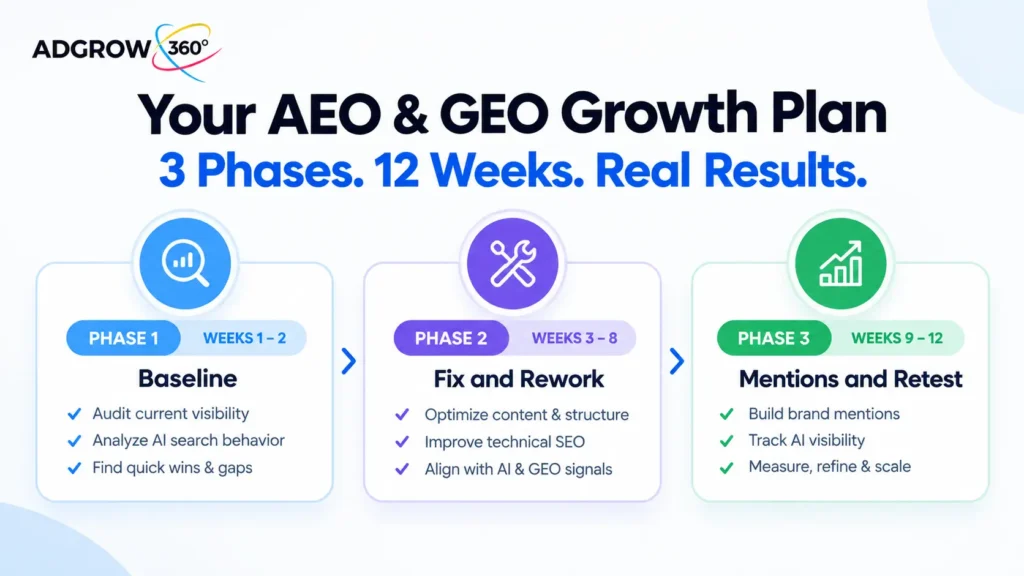
In the first 90 days, a good AI SEO agency should give you a dated baseline, fix whatever blocks AI crawlers, rework a short list of priority pages, rerun the same prompts and tell you plainly what moved. Treat this as a planning frame, not a benchmark.
- Weeks 1 to 2: baseline and access check. Agree on 15 to 20 buyer prompts. Run them across ChatGPT, Gemini, Claude, Perplexity and Google AI Overviews, more than once, and write down the dates. Check that AI crawlers can reach your pages. Pull AI impressions from Search Console’s generative AI report and citation data from Bing Webmaster Tools’ AI Performance report.
- Weeks 3 to 8: fix and rework. Clear the technical blockers and inconsistent brand facts. Rewrite the agreed key pages around real buyer questions: a direct answer up top, original data or expert quotes, and sources. Log every change. Your side signs off on every fact.
- Weeks 9 to 12: mentions, retest, decision. Work on genuine third-party mentions, rerun the same prompts the same way and compare with the baseline. Finish with a written recommendation for the next phase.
Different work moves at different speeds. Crawler access fixes can take effect within days, since OpenAI says robots.txt changes reach its systems in about 24 hours. Reworked pages need to be recrawled, so content effects take weeks or months. The 90-day report shows direction, not a final result.
And plan for upkeep. An analysis of 3.5 million citation events by Scrunch and Stacker found the average source loses half its citation activity in about 4.5 weeks. A one-off burst of content fades fast, so ask every agency how often it refreshes pages and how it decides what to update.
How to test any AI SEO agency in 30 minutes
Before you sign with anyone, check whether the agency gets cited for its own topics. If it can’t earn citations for itself, why trust it to earn them for you? The test takes about 30 minutes.
- Write 10 prompts a buyer would type, like “how do I choose an AI SEO agency” or “best AI SEO agency for [your industry] in [your city]”.
- Run each prompt in five engines: ChatGPT, Gemini, Claude, Perplexity and Google AI Overviews. Run each one twice, ideally on different days, because answers change between runs.
- Write down what you see. Was the agency named, cited with a link, both, or neither? Who got cited instead?
- Look at the agency’s own site. When was its last article published? Does it write about AI search at all? Are its pages built with direct answers, tables and sources?
- Count the share of runs, not the rank. In the SparkToro and Gumshoe.ai study, exact positions were close to meaningless, while the share of responses where a brand appeared held up better.
A simple log like this is enough:
Engine | Prompts | Runs | Agencies named (visible part of the answer) | Sources shown | Notes |
|---|---|---|---|---|---|
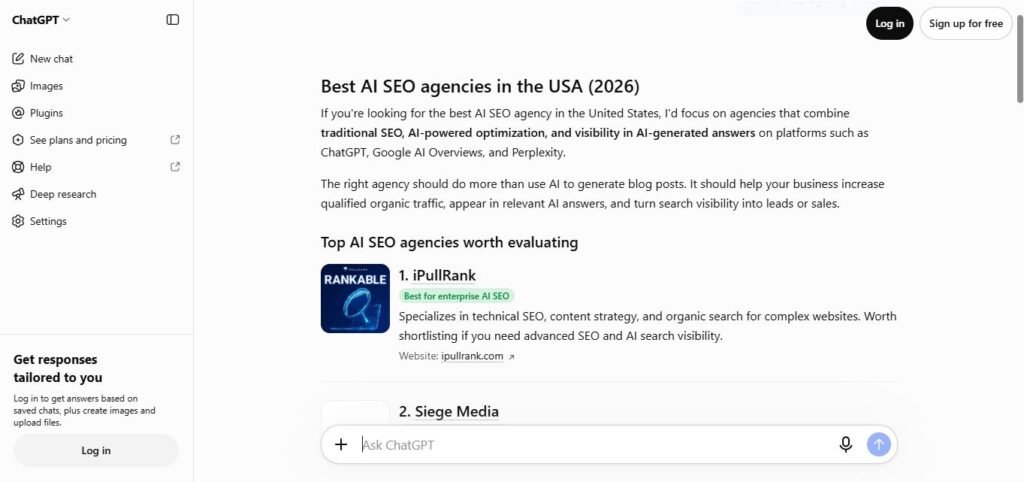
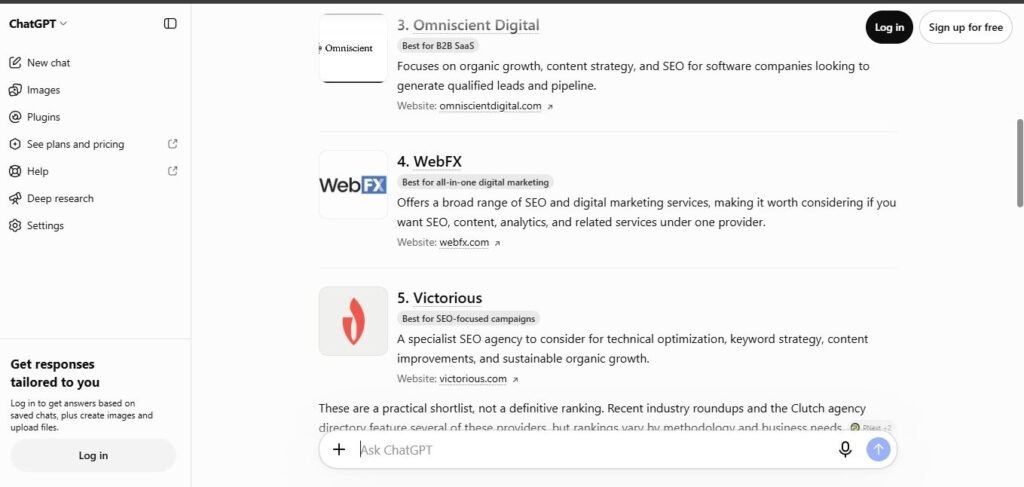
ChatGPT (signed out) | 1 | 1 | iPullRank, Siege Media, Omniscient Digital, WebFX, Victorious | Agency websites linked; one source chip partly cut off | Called its list a shortlist, not a definitive ranking |
Gemini (signed out) | 1 | 1 | iPullRank, First Page Sage, Minuttia, Victorious, Ignite Visibility, Go Fish Digital, Thrive, Intero Digital | None visible | Grouped agencies by specialty |
Claude | 1 | 1 | iPullRank, First Page Sage, Omniscient Digital, LinkGraph, NP Digital, WebFX, Thrive, Intero Digital, Directive, Siege Media | Roundup sites such as charleagency, dageno and seoprofy | Quoted a $10,000 to $15,000 monthly range for enterprise work; called results shortlists, not verdicts |
Perplexity | 1 | 1 | First Page Sage, Omniscient Digital, Searchbloom, Victorious, Thrive, iPullRank, Seer Interactive, Siege Media, WebFX | macraes, searchbloom, thriveagency and others | Answered in tables by best fit |
Google AI Mode | 1 | 1 | iPullRank, Fuel Online, Loopex Digital, First Page Sage, Omniscient Digital, Coalition Technologies, Go Fish Digital | FactoryJet, Coalition Technologies, First Page Sage, WebGuruz, a Reddit thread | Quoted retainer prices of about $1,500 and $10,000 a month |
Our test results
On 29 October 2026 we ran one prompt, “Best AI SEO agency in USA“, once in each of the five engines. ChatGPT and Gemini were signed out. Some of the screenshots only captured part of a longer answer, so read every count below as a minimum. This is a small pilot, not a ranking, and not an endorsement of any agency.
- One name showed up everywhere. iPullRank was named in all five engines.
- Two came close. First Page Sage and Omniscient Digital each appeared in four of the five.
- Four appeared in three. Victorious, Thrive, WebFX and Siege Media.
- Most sources were roundups. The source chips we could see were mostly “best agencies” lists and agency sites, plus one Reddit thread. Hardly any were how-to guides.
- Engines quoted prices. Claude and Google AI Mode both gave monthly figures, from about $1,500 to $15,000.
- Engines hedged. ChatGPT and Claude both called their answers shortlists, not rankings.
- None of the five guides we compared against appeared in the visible answers. That makes sense: “best agency” asks who to hire, while this post answers how to choose.
AdGrow360 was not named in any of these answers. This is our baseline for this prompt. We will re-run the same test on 1 jan 2027 and update this section with what changed.
So what does this mean for you? If you want to be named when buyers ask “who’s the best”, being listed in third-party roundups and directories matters at least as much as your own pages. If you want to be cited when they ask “how do I choose”, you need a page that answers that exact question. Run the second prompt too and add it to the table.
One caution: a single result proves very little. Personal memory and chat history change what ChatGPT and Claude return, and there’s no such thing as a neutral prompt. Use the test to compare agencies with each other, not to prove a number.
Frequently asked questions about choosing an AI SEO agency
What is an AI SEO agency?
It’s an agency that helps your business show up in AI-generated answers as well as regular search results, across ChatGPT, Gemini, Claude, Perplexity, Copilot and Google AI Overviews. The label is loose, though. Ask whether the work is AI search optimization, SEO done with AI tools, or AI-written content at scale. They’re very different services.
Is AI SEO different from traditional SEO?
Partly. Google says optimizing for its generative AI features is still SEO and needs no special markup. Other engines have their own crawlers and sources, and measurement is messier because answers change on every run. AEO and GEO are the usual names for the AI-specific layer, and it still sits on top of strong fundamentals.
Can an agency guarantee that ChatGPT will mention my business?
No. The engines belong to other companies and their answers change from run to run. A responsible agency promises a method, a measured baseline and honest reporting. It doesn’t promise a placement.
How much does an AI SEO agency cost?
It depends on scope, site size, market and how much implementation is included, and there’s no neutral price benchmark. Compare deliverables, not rates. A fixed-scope first phase of about 90 days is a sensible way to test a provider before committing longer.
How long does AI SEO take to show results?
Technical access fixes can work within days. Reworked pages need to be recrawled, so content effects usually take weeks to months, and there’s no reliable public timeline. Judge the first 90 days on two things: did the agency deliver what it promised, and did your baseline move the right way?
How do I know if an AI SEO agency is working?
Check it against data you can open yourself: Google Search Console’s generative AI report, Bing Webmaster Tools’ AI Performance report, GA4 referrals from AI assistants, and your CRM. Third-party AI visibility tools sample prompts, so ask to see the prompt list behind every chart.
Do I need a separate GEO agency, or can my SEO agency handle it?
Most businesses don’t. If your current SEO provider can answer the 12 questions in this guide, keeping everything with them is simpler. Hire a specialist if they can’t, or if you want one partner for both search and AI answers.
Can I do AI SEO myself?
Yes, if your site is small and someone on your team can edit pages and robots rules. Start with a prompt list, a baseline across the main AI engines and a technical access check. Bring in help when you’re short on time or access, or when the site is big enough that implementation becomes the bottleneck.
About AdGrow360
AdGrow360 is an India-based digital marketing agency that works with US clients on SEO, answer engine optimization and paid media. If you’d like to see how we approach AI search visibility, start with our AI SEO service page.
Author- Anas Khan- SEO Executive at Adgrow360.