by: Anas Khan
-
September 19, 2026
-
Comments (0)
Try searching “plumber near me” on Google right now. There’s a decent chance you won’t get the usual three options — you might only get one, or two.
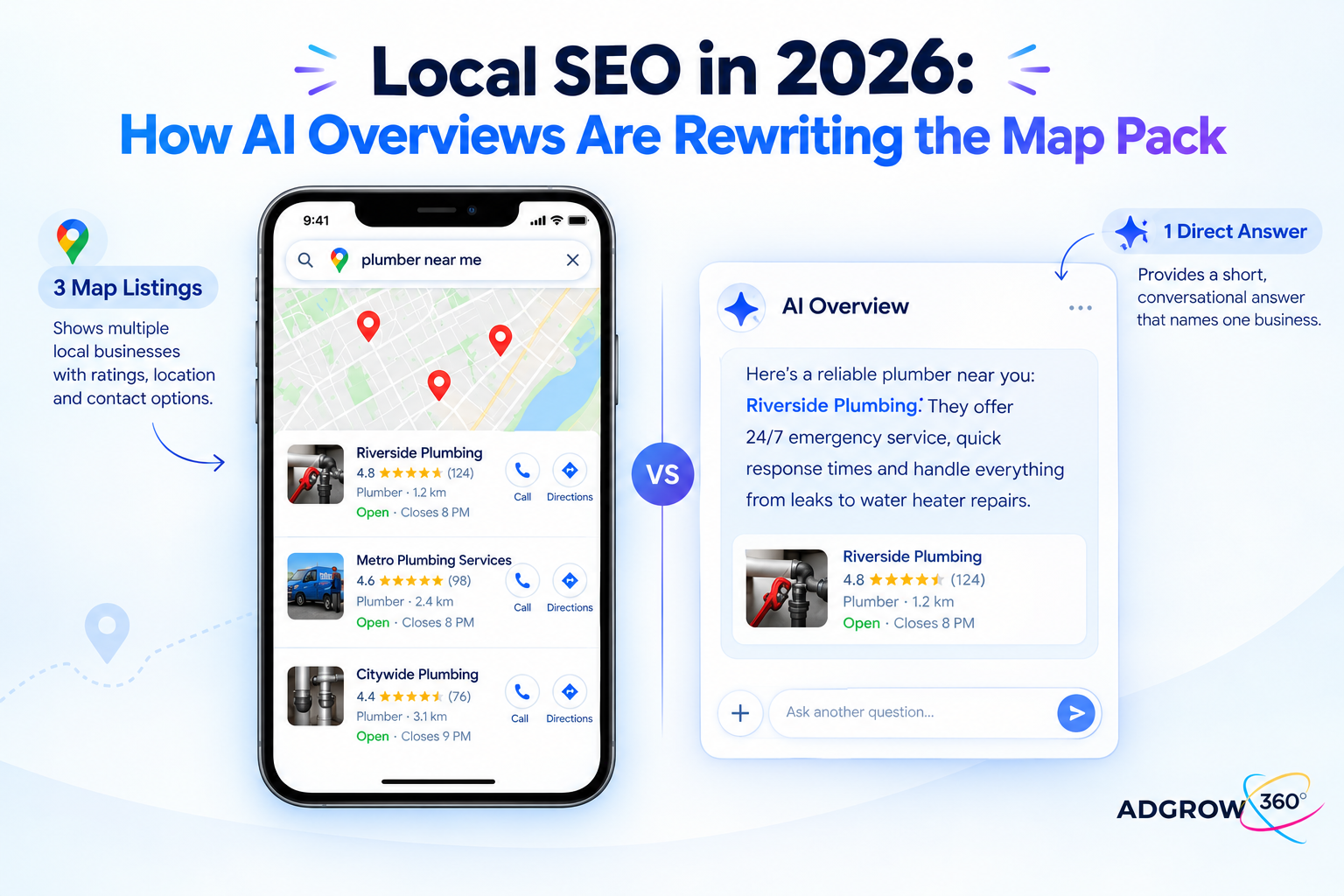
That’s a real, measurable shift, not a scare story dreamed up to justify an audit. Late in 2025, Google began testing an AI-built alternative to the Map Pack: instead of three listings, searchers see a compact written answer that calls out just one or two businesses by name. That test has since grown into a genuine rollout spreading through 2026, and early figures suggest some businesses have lost half their visibility or more because of it. Researcher Joy Hawkins quantified exactly how much narrower the field has become: one tracked set of searches found 5,943 distinct businesses appearing anywhere across the AI-style local packs, compared with 18,330 distinct businesses that showed up across the traditional three-packs for those same queries.
Sit with that for a second. This isn’t just about each individual search returning fewer names — sure, three slots became one or two. Scale that across a whole market, though, and only roughly a third of businesses get any shot at showing up at all. The remaining two-thirds are effectively absent from that results format entirely.
Short version, if you’re skimming: AI Overviews haven’t pushed the Map Pack aside, and nothing currently suggests they will. What’s actually happened is that local search has split into two overlapping systems, both built from the same underlying material — your Business Profile, your reviews, your website — but interpreted very differently depending on what gets typed. Nail the fundamentals and both systems will surface you. Ignore them, and AI just makes that shortfall impossible to miss, and fast.
What follows covers the real shifts, what’s stayed the same, and the moves that actually matter because of it.
Map Pack vs AI Overview: What's Actually Different
People treat these as one battle over three positions. They aren’t.
Local Pack, 3-pack, Map Pack — whatever you call it, this is the map-with-three-listings block that’s been the default local search result for roughly ten years. Proximity, your Google Business Profile, and reviews decide who lands there, and it’s aimed at searchers who’ve already made up their mind and just need a business to contact.
An AI Overview operates on a different model — a generated response that can call out specific business names, pulling together that same base data along with what’s actually on your website and how much you get referenced across other sites. It’s aimed at someone who hasn’t decided yet.
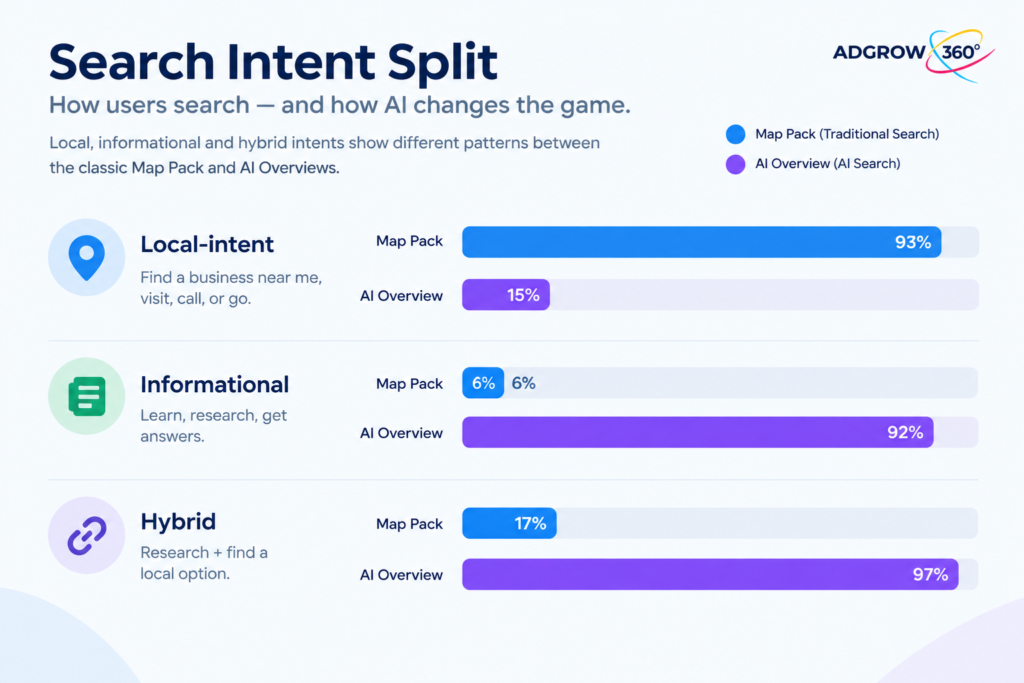
Here’s the sharpest way to separate them: what actually triggers each one. Whitespark tested 540 live queries spanning three US cities and six industries, sorting them by local, informational, and hybrid intent. The split was stark — local packs appeared on 93% of local-intent searches but a mere 6% of informational ones, while AI Overviews barely touched local-intent queries (15%) and instead dominated informational (92%) and hybrid searches (97%). A hybrid query looks something like “is it worth calling a plumber for a slow drain” — a real question that’s also a buying signal.
| Map Pack (3-Pack) | AI Overview | |
|---|---|---|
| What it looks like | Map plus three business listings | Written summary, often naming 1–2 businesses |
| Best suited for | “Near me” searches, ready-to-call intent | Research and side-by-side comparisons |
| Shows up on local-intent queries | ~93% of the time | ~15% of the time |
| Shows up on informational queries | ~6% of the time | ~92% of the time |
| Shows up on hybrid queries | ~17% of the time | ~97% of the time |
| What drives ranking | Proximity, GBP, reviews | Same signals, plus website content and third-party mentions |
| Typical click behavior | High-intent calls and direction requests | Frequently zero-click |
(Intent-split figures: Whitespark, based on 540 queries across Houston, Phoenix, and Denver in six industries.)
In short, “AI Overviews local SEO” isn’t a single playbook — treat it as two, operating side by side. Rather than picking between Map Pack optimization and AI Overview optimization, what’s actually needed is a profile robust enough to land the ready-to-buy moment, paired with content solid enough to earn a mention during the research that typically precedes it.
Here’s a number worth keeping in mind before spending anything on AI-citation chasing: Ahrefs looked at 300,000 keywords and measured an average 34.5% drop in click-through rate to the #1 organic result whenever an AI Overview sits above it. That’s meaningful traffic walking away, not statistical noise. It’s also the reason “ranking well” by itself stopped being the finish line — what counts now is showing up as the name the AI chooses, rather than occupying position ten where almost nobody looks.
Google Business Profile and AI Search: What Ask Maps Changed
The most under-discussed local-search story this year isn’t a results-page tweak — it’s that Google built a full conversational layer straight into Maps itself, rather than stopping at the search page.
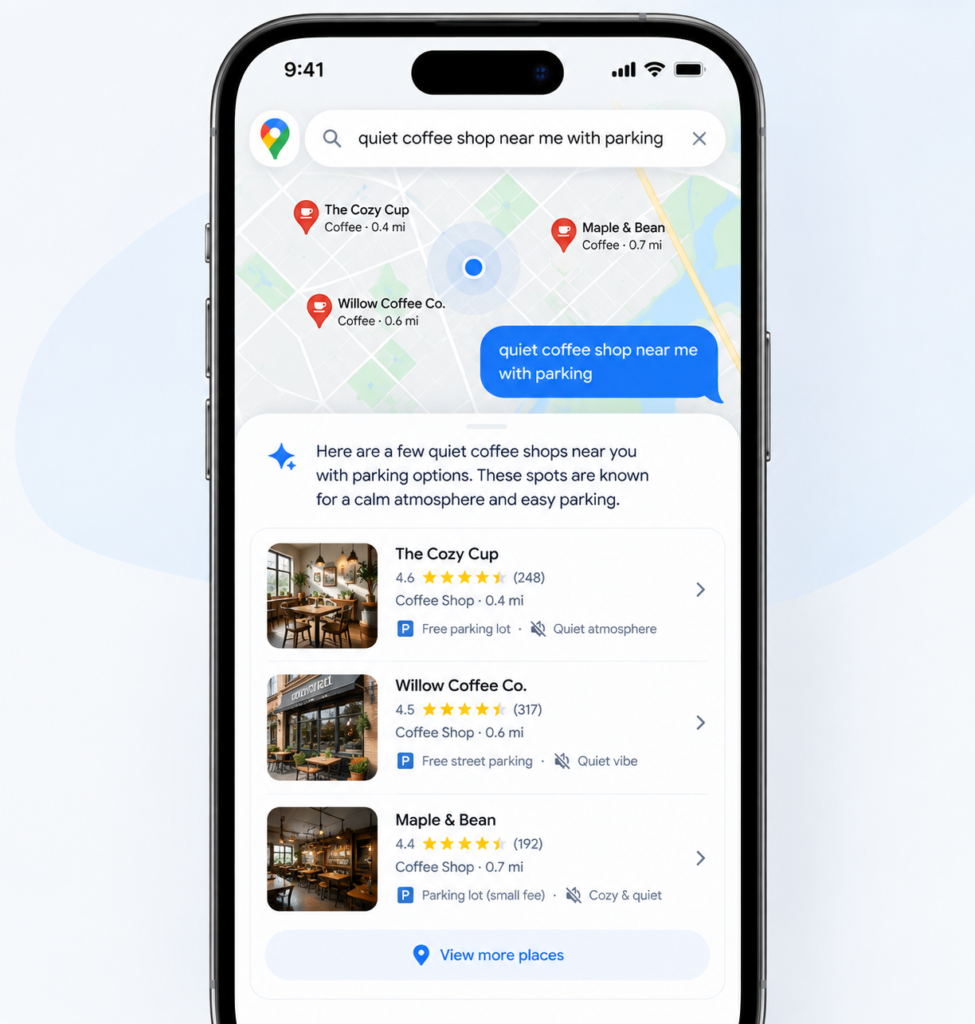
That capability — Ask Maps is built on Gemini and went live March 12, 2026. Rather than hunting for a place by category or keyword, someone can now put an actual question to Maps directly, something like where to charge a dying phone without waiting in a long coffee-shop line, and get back an answer drawn from review text, business sites, and uploaded photos. Behind it sits a Google dataset spanning upwards of 300 million places and more than 500 million contributed reviews, and the system goes beyond simple answers into personalization — a past pattern of searching out vegan spots, for instance, will quietly shape which restaurant it suggests for a group dinner.
A lot of what’s published about Ask Maps still frames it as limited to the US and India. That description is now outdated: as of August 6, 2026, the feature reached Australia, Brazil, Canada, Indonesia, Japan, and Mexico, alongside upwards of 150 additional countries and territories where it works in English. The same update added a memory layer too — Ask Maps can look back at previous chats when someone follows up, currently running inside a “Personal Intelligence” mode (Gmail is the first connected source) that stays off by default until a user opts in.
One more shift matters here, especially for anyone who treats reviews as proof of legitimacy: Google states that Gemini now helps identify review fraud sooner, freezing new submissions when it notices abnormal bursts of activity and flagging possible edits to business owners before problems compound. The upshot is that the review data underpinning so much of AI search now faces closer scrutiny — a plus if your reviews are real, a problem if you’ve ever nudged the numbers.
Practically speaking, your Google Business Profile now does double duty — it still feeds the Map Pack, but it’s also the live input Ask Maps consults directly when answering someone in the moment. A profile listing nothing more than “services: home repair” gives the system very little to work with if a searcher asks something pointed, like who can resurface a driveway without cracking the neighbor’s pavers. Load that same profile with real attributes, an accurate category, and reviews that name specifics, and there’s suddenly a lot more for Ask Maps to draw on.
Local SEO Ranking Factors in 2026: What Actually Moves the Needle
Whitespark runs this survey annually, gathering top local SEO practitioners to weigh in on what’s genuinely moving rankings. Forty-seven experts took part in the 2026 round, scoring 187 separate ranking factors — and for the first time, AI Search visibility got pulled out as its own standalone category rather than folded into the Map Pack or organic results.
| Ranking factor group | Approx. weight in Map Pack | Where it’s heading in 2026 |
|---|---|---|
| Google Business Profile signals | ~32% | Still the single largest lever you can directly control |
| Review signals | ~20% | Up from roughly 16% in 2023 — how often reviews arrive now matters more than the total count |
| On-page website signals | Upper teens % | Climbing faster than any other category |
| Link signals | ~15% | Down slightly; local links still outweigh national ones |
| Citations (NAP consistency) | Smaller share, edging down | Still foundational — more on this below |
| Proximity | ~55% of the overall decision | Entirely outside your control |
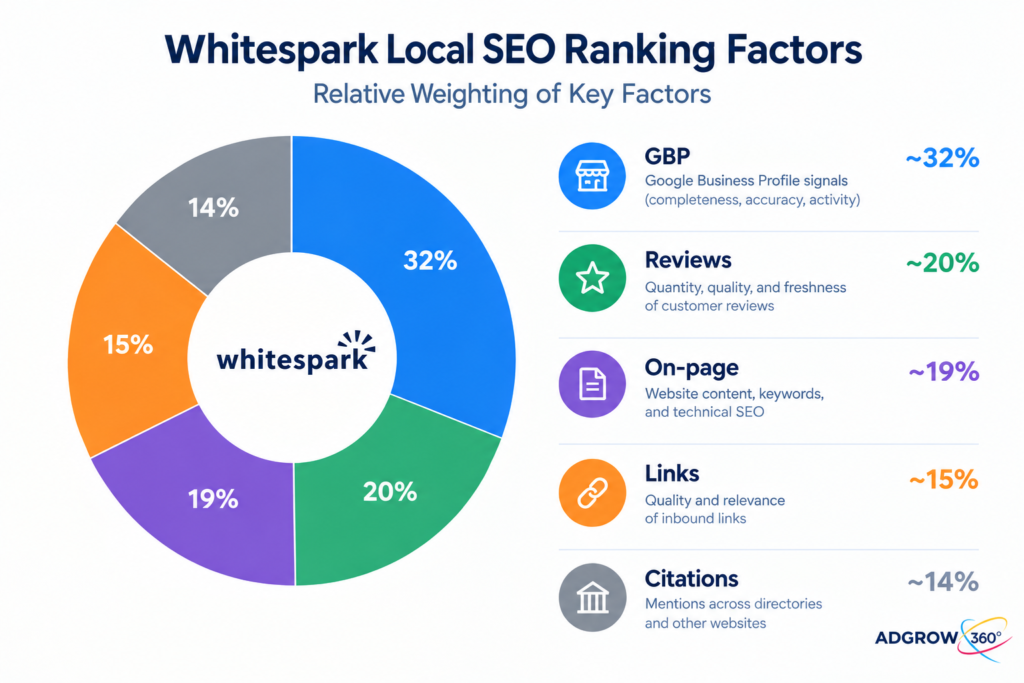
A handful of these numbers deserve more than a glance.
On-page content is punching above its weight this year. Per Whitespark’s numbers, giving each service its own dedicated page is the top-ranked factor for local organic results, and the second-ranked factor for AI visibility. That means something more than a homepage that crams five offerings into one bulleted section — it means a genuine standalone page per service that actually explains what the work involves.
The citation numbers landed strangely. Per Whitespark, citation weight edged down roughly half a point this year, part of a longer-running decline — though Darren Shaw, who leads the survey, pushes back on taking that at face value, since AI search keeps demonstrating just how much trust depends on citations even as their scored weight shrinks. That pushback is worth heeding: a dip in one spreadsheet cell isn’t a green light to skip citation cleanup. NAP consistency is something an AI system checks in a matter of seconds, and getting it wrong is a fast route to being silently overlooked.
2026’s defining trend might be behavioral signals. Weight is climbing steadily for posts, photos, click activity, calls, and direction requests — Google is tilting toward businesses that show visible, ongoing engagement rather than ones that set up a profile once and left it untouched since.
People underestimate how much being open actually matters. Whitespark now places accurate business hours as the 5th most influential local pack factor, with visibility measurably slipping during the last hour before a listed closing time. Say your posted hours say 5pm but the doors don’t actually lock until 6 — you’re silently forfeiting every search that comes in around that 5 o’clock mark.
"Near Me" Searches in the Age of AI
If part of you has been dreading an AI takeover of everything, here’s some good news: the “near me” search itself is basically unchanged. The real shift is in how much guesswork Google now does before a person finishes typing anything at all.
According to BrightLocal, about 76% of voice searches carry local intent already, and voice queries for “near me” specifically have climbed roughly 150% since 2020. The larger shift, though, is that saying “near me” is becoming unnecessary — Google now leans on location data and surrounding context to make that call on its own. Type just “coffee shop” into your phone and it reads as a local search regardless of whether you added the qualifier.
Here’s the practical upshot: literally matching content to the phrase “near me” no longer carries the weight it once did. What counts more is whether a business can satisfy the fuller, more specific version of that query AI-powered search now expects say, “budget-friendly hotel walking distance from downtown with late checkout,” instead of the bare “hotel near me.” Ask Maps is designed around exactly this sort of detailed, conversational ask, and that’s why filling in every applicable profile attribute — hours, parking, accessibility, the ambiance descriptors your category offers — has become a near-me ranking signal in its own right, not a nice extra.
How to Get Cited by ChatGPT, Perplexity, and Gemini — Not Just Google
Most local SEO advice stops mattering right about here, because it was written back when Google was the only AI-adjacent platform agencies needed to think about. ChatGPT and Perplexity run on entirely different logic than Google’s index does, and folding all three into a single “AI search” bucket is precisely how a business winds up invisible across all of them.
There’s no local-business index inside ChatGPT itself. What it has instead is three inputs to work from: material absorbed during training, live results pulled through its Bing-based search when browsing is active, and outside references — think reviews, directory listings, and press or blog coverage naming a business and where it’s located. That last input explains why claiming and completing a Bing Places profile, a step most businesses skip entirely, ranks among the cheapest, highest-return moves available right now. It flows directly into what ChatGPT finds when it browses.
Perplexity runs on a different logic altogether, weighting live crawling so heavily that fresh, well-maintained on-page content outperforms accumulated domain authority there.
Of the three, Google’s AI Overview is the outlier — not a standalone system but a layer built on top of the existing search index plus whatever schema markup a site provides, which means the fundamentals discussed earlier in this piece transfer over largely unchanged.
A few tactics hold across all three platforms, we go deeper on the ChatGPT-specific ones in How to Get Your Brand Cited by ChatGPT:
Build sections that work independently of each other. These platforms lift out answer-sized fragments rather than ingesting whole pages. Put the direct, one-or-two-sentence answer at the top of each section before elaborating — which, notice, is the format this entire piece has followed. That’s not decoration; it’s the actual mechanism these tools use to extract something worth quoting.
Put LocalBusiness and FAQPage schema on every relevant page, at minimum. The FAQPage type specifically is what feeds Google’s AI Overview snippet generation.
Give AI visibility its own monthly check, apart from standard rank tracking. Run an identical prompt — something like “best [service] in [city]” — through ChatGPT, Perplexity, and Google’s AI Mode every month, and log whichever business gets mentioned. It’s an imprecise method, but right now it’s about as close as these platforms get to letting you track rank at all.
Refresh things before they go stale. Every AI platform has its own quiet way of burying outdated pages. Giving service pages and GBP listings a once-a-quarter look-over is a sensible floor — and anything touching price, hours, or availability needs checking on a tighter cycle than that.
A Realistic 2026 Local AI Visibility Checklist
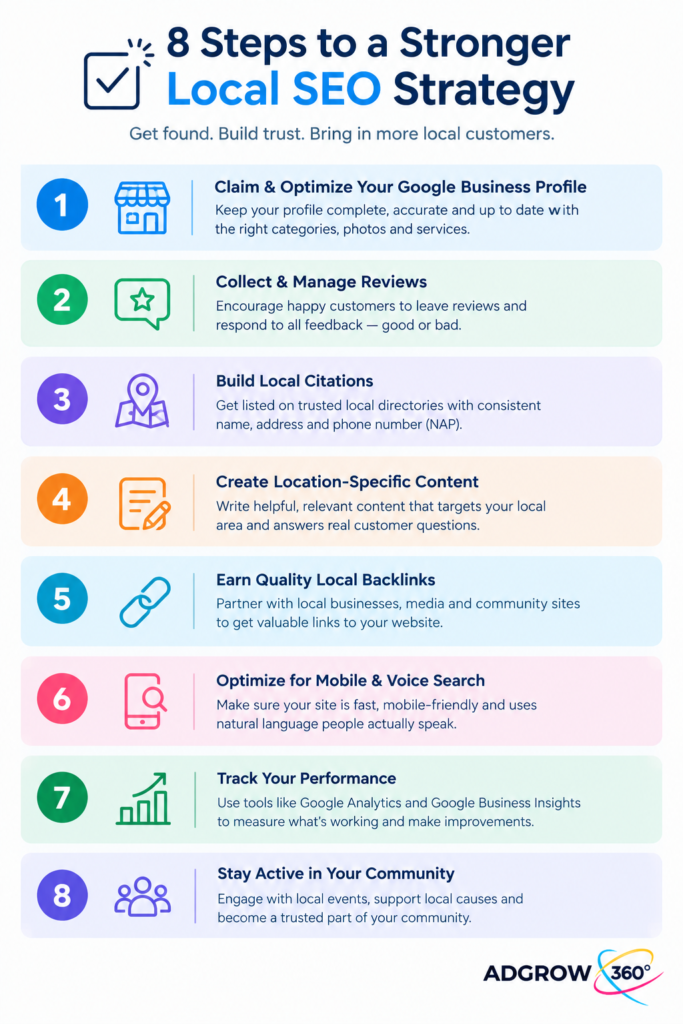
Set the audits and retainer pitches aside for a moment. If you’re doing this yourself, here’s the order that actually matters, roughly ranked by effort against payoff:
- Fix your Google Business Profile’s category and completeness first. It carries roughly 32% of Map Pack weight and feeds Ask Maps directly — no other item here matters more.
- Check NAP consistency across your major directories. A few inconsistent listings can silently cancel out everything else you’ve fixed.
- Build a standalone page for every service instead of one page listing them all. Whitespark’s numbers rank this as the single strongest on-page signal they measured. Pair that with fast indexing so each new page shows up before a competitor’s does.
- Claim and fully complete your Bing Places listing. A five-minute task that happens to be the single most overlooked way to boost ChatGPT visibility specifically.
- Layer in LocalBusiness and FAQPage schema markup.
- Build a habit of responding to reviews, rather than just requesting them. How recent and specific your review text is now counts for more than a high raw star average.
- Get your listed hours accurate down to the minute — closing time above all.
- Make the ChatGPT/Perplexity/AI Mode name-check a monthly habit, and note who keeps beating you to the mention.
The Honest Timeline
AI citation visibility doesn’t happen in a week, and anyone claiming otherwise is overselling. Expect local pack movement in roughly 60 to 90 days once the fundamentals above are genuinely addressed; citation visibility in AI tools tends to trail even further behind, partly because it hinges on third-party mentions building up gradually rather than anything you control on your own site alone.
Here’s a final observation, earned from watching Google run this cycle more than once before: no SERP feature is permanent. AI Overviews, Ask Maps, and whatever eventually supersedes them are all liable to be scaled back, redesigned, or replaced without much warning — it’s a pattern Google has repeated for years. The winners in the long run won’t be the businesses scrambling after whichever feature is trending this month. They’ll be the ones that kept a complete, accurate profile, earned honest reviews, and built a site that genuinely answers what people want to know — because that combination is what every generation of local search, AI or otherwise, has rewarded for something like ten years running.
Frequently Asked Question
What exactly is an "AI Overview local pack," and how does it differ from the standard 3-pack?
Since late 2025, Google has been testing (and gradually expanding) an AI-generated alternative to the classic Map Pack. Rather than the usual three business listings, it produces a brief written answer that names just one or two businesses. The gap in reach is significant: one tracked dataset showed only 5,943 distinct businesses surfacing across the AI-style packs, against 18,330 distinct businesses that appeared in the standard three-pack for an identical set of searches.
Is the Map Pack going to disappear in favor of AI Overviews?
Evidence doesn’t point that way. The Map Pack continues to dominate quick, transactional “near me” searches, appearing on about 93% of local-intent queries. AI Overviews, by contrast, show up mostly on informational and hybrid searches (92% and 97%) — the stage where someone’s still sizing up choices rather than ready to dial a number.
What's the top local SEO ranking factor heading into the rest of 2026?
Google Business Profile signals they account for close to a third of Map Pack ranking weight in Whitespark’s 2026 survey of 47 local SEO experts. Inside that category, getting the primary listing category right and keeping the profile genuinely complete beats out any single review or backlink.
Are "near me" searches still triggering the Map Pack, or has AI taken those over too?
Mostly, yes — straightforward transactional phrasing like “near me” still calls up the Map Pack in most cases. The real change is that Google can now recognize local intent without anyone spelling it out, using location signals and conversational tools such as Ask Maps to fill in that gap automatically.
What separates getting cited by ChatGPT from ranking well in Google's AI Overview?
Google’s AI Overview is basically an extension of standard organic search — same index, same core signals, plus whatever your schema and on-page content add. ChatGPT works from a completely different toolkit since it has no local listings database at all: training data, live Bing searches, and mentions from other sites are what it’s got. That’s the whole reason a properly filled-out Bing Places profile, a step most businesses skip, punches so far above its weight for ChatGPT. For the fuller breakdown of how AEO, GEO, AIO, and traditional SEO fit together, see our AEO vs GEO vs AIO vs SEO guide.
What's the simplest way to check whether AI tools are actually surfacing my business?
Pose the question a customer actually would to ChatGPT, Perplexity, and Google’s AI Mode — something in the shape of “best [service] in [your city]” — and note whichever business gets named. If it’s someone else, line up their profile completeness, how recent their reviews are, and their site content against your own to spot the gap.
Now that Ask Maps exists, does my Google Business Profile carry more weight than before?
If anything, more. The system pulls directly from category accuracy, listed attributes, photos, and what your reviews actually say in order to handle a conversational question. A bare-bones profile used to just mean weaker performance inside the Map Pack — now it also means Google’s conversational layer may leave that business out of the answer altogether.
How frequently should I be updating content to hold onto AI search visibility?
No fixed schedule exists, but content that’s gone stale gets buried across every AI-driven surface, Google included, usually without warning. Touch base on your core service pages and GBP details at least once a quarter — and check anything involving pricing, hours, or availability more often than that, since those go out of date the fastest.