by: Anas Khan
-
August 13, 2026
-
Comments (0)
Quick answer: Search Generative AI Control is the Search Console setting that decides whether your site can appear in Google’s AI Overviews, AI Mode, and Discover’s AI summaries. Google switched it on June 3, 2026, and started enforcing changes on June 17. It runs independently of your rankings — Google says excluding your site from AI features has no bearing on how you perform in regular Search.
Ask ten SEOs in early 2026 whether you could keep a single page out of AI Overviews without dragging it out of regular Search too, and you’d have gotten the same answer ten times: not really. Robots.txt was never built to touch AI features specifically. Noindex solved the problem by wiping out everything, rankings included. Nosnippet got closest, but it still stripped your ordinary snippets in the process — there was a sledgehammer available, not a scalpel.
That changed on June 3, 2026. Google dropped two new pieces into Search Console at once: a report that finally shows how often your pages get pulled into AI Overviews, AI Mode, and Discover’s AI summaries, and a toggle that separates “do I rank” from “do I get cited in an AI answer” for the first time. Here’s what both actually do, how the toggle differs from tools like Google-Extended, and what the evidence so far says about whether switching it off is a smart move.
What Is Search Generative AI Control?
Search Generative AI Control is the Search Console setting that decides whether your pages are even eligible to show up inside AI Overviews, AI Mode, or Discover’s AI-written summaries. It’s a property-level switch, tucked under Settings, and it’s currently the only Google-built tool that separates AI-feature visibility from ordinary Search visibility as two distinct questions.
It didn’t appear in a vacuum, either. Google first mentioned, in January 2026, that it was exploring some kind of AI opt-out — the same month the UK’s Competition and Markets Authority (CMA) opened a formal consultation demanding one. By June, that consultation had become a binding conduct requirement, and Google began testing the toggle on UK properties within days of it landing. That’s the real origin story: less “product team ships a nice-to-have,” more “regulator sets a deadline, product team builds to it.” It’s also why the rollout started in one country instead of everywhere at once, and why more changes are already scheduled on a clock Google doesn’t fully control.
Key dates:
| Date | What happened |
|---|---|
| January 2026 | Google acknowledges it’s exploring an AI opt-out; the UK CMA opens its consultation |
| June 3, 2026 | The control and the Generative AI performance report launch, UK-only |
| June 17, 2026 | Google starts actually respecting Include/Exclude changes |
| July 2026 | The control begins appearing on non-UK accounts, including some in the US |
| August 11, 2026 | The performance report is spotted expanding globally |
Include vs. Exclude vs. Inherit (Search Console): What Each Setting Actually Does
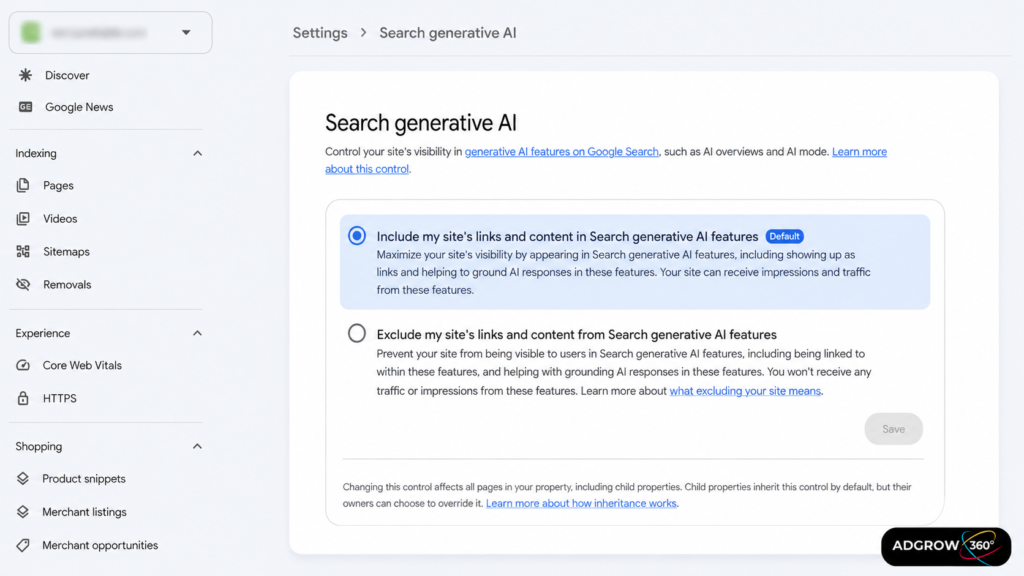
Start with Include, since that’s what every property gets by default and most sites will never need to touch. Leave it alone and nothing changes: your pages stay fair game for AI Overviews, AI Mode, and Discover’s AI summaries, exactly as they’ve always been, whether or not you’ve ever thought about it.
Flip to Exclude and the effect is total, not partial. Google can no longer cite your pages, link to them, or draw on them to build an AI-generated answer, across all three surfaces simultaneously — there’s no way to block AI Mode while leaving AI Overviews untouched, or vice versa. The part that catches people off guard: the change isn’t instant. Google’s own documentation puts the lag at roughly one to two days once your setting takes effect, and caching can stretch that out further on some properties. Also worth knowing: Exclude doesn’t switch the AI Overview itself off for your target queries. Google still generates an answer for the searcher — it’s just built from whichever other, still-eligible sites can fill the gap, possibly covering the exact ground your page would have.
Inherit is the option almost nobody sets on purpose — it’s simply what happens automatically once a property has a parent. Run a domain with several subdomains or URL-prefix properties sitting under it, and each child quietly mirrors whatever the parent is currently set to, indefinitely, unless someone manually breaks that link at the child level. Change the parent later, and every inheriting child moves with it. Depending on how your properties are organized, that’s either exactly the centralized control you wanted, or a landmine waiting for whoever forgets which child properties are still set to follow the parent.
How to Find the Search Console AI Overviews Toggle
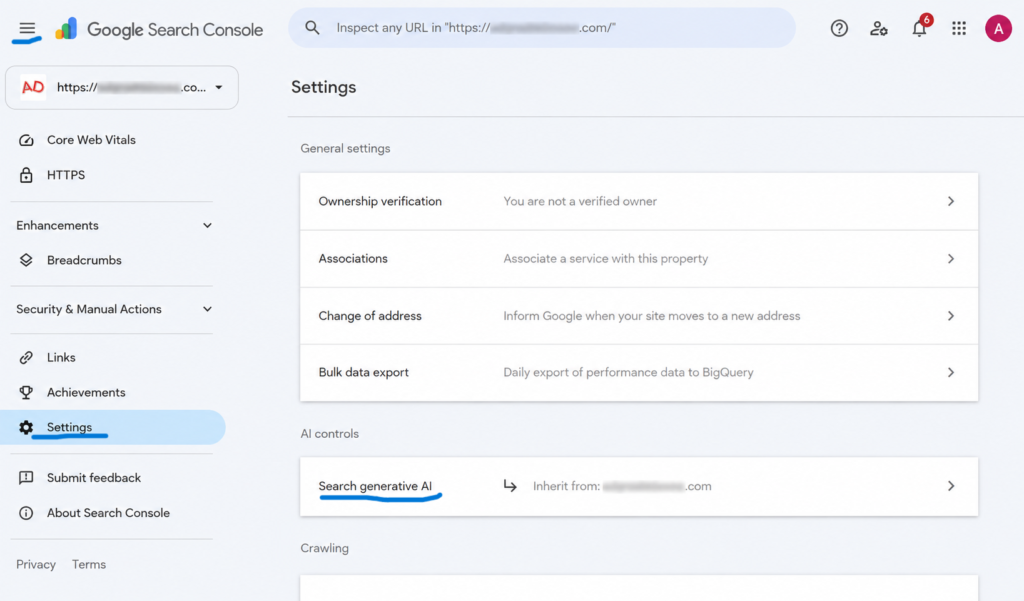
- Open Search Console and pick the property you want to check.
- Head to Settings in the left sidebar.
- Look for AI controls, then Search generative AI — some accounts see this nested one level deeper than others, since Google still appears to be adjusting the exact placement as more properties get access.
- If it’s live on your property, you’ll see the current value — Include, Exclude, or Inherit — plus a note on where that value is being inherited from, if relevant.
- Nothing there yet? That’s expected. As of this writing, it’s still a partial rollout, not a default turned on for every property.
One access note worth flagging: based on early hands-on reporting from technical SEO consultant Brodie Clark, only Search Console users with Owner-level permission can actually change this setting. Full and Restricted Users can typically see the current value but not modify it — the same tier Google reserves for its other high-stakes settings.
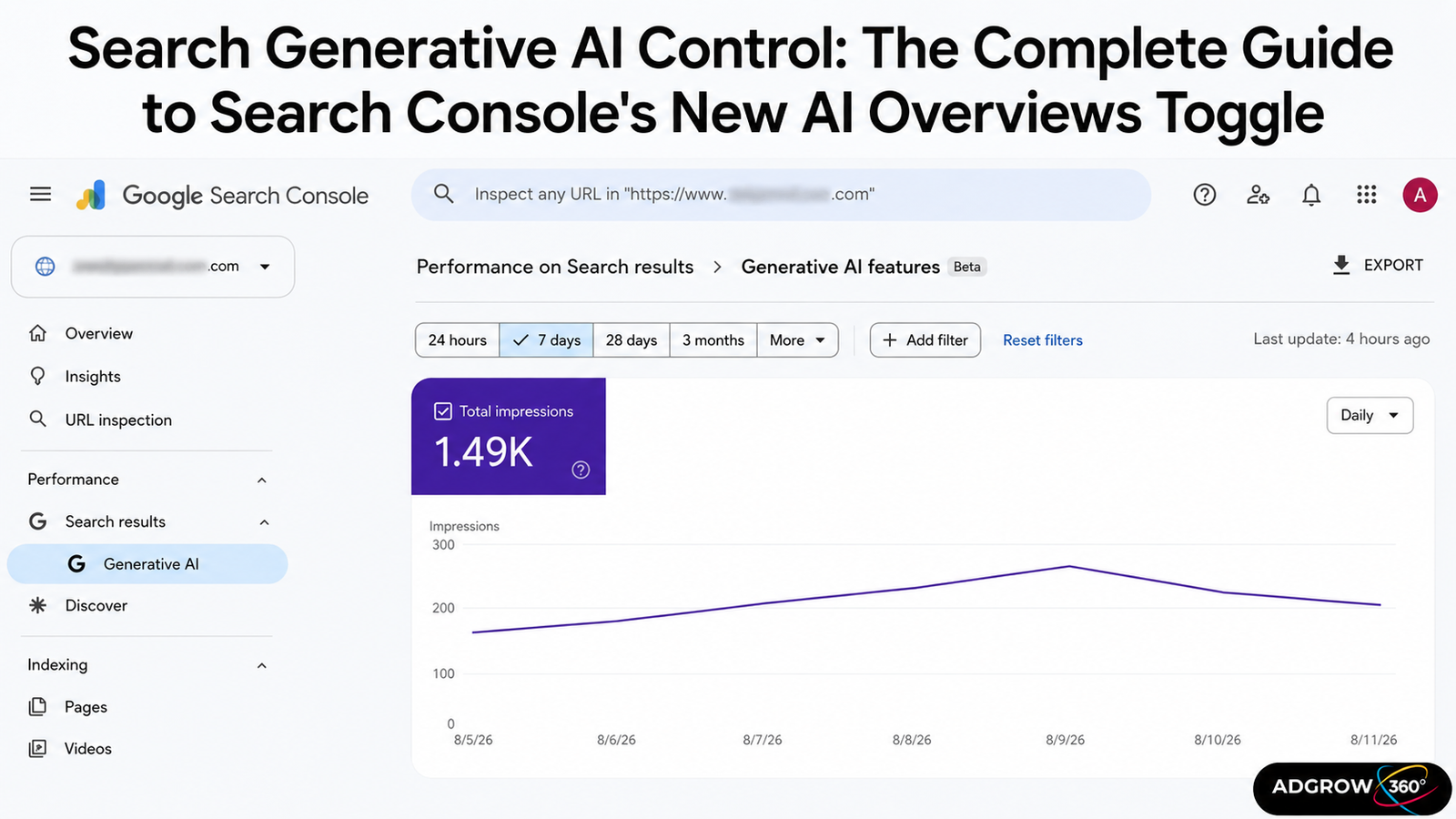
The New Search Generative AI Performance Report: What It Shows (and What It Doesn't)
Pull the report up and there’s one core number: impressions, meaning how often a URL from your site got pulled into an AI Overview, an AI Mode response, or a Discover AI summary. You can slice that number four ways. By page, which is arguably the most useful cut, since it tells you exactly which URLs Google’s AI systems already trust enough to cite. By country, handy if your audience isn’t concentrated in one market. By device, though that particular breakdown only applies to the Search view, not Discover. And by date, anywhere from an hourly window up to a monthly trend line.
What’s missing is the part that frustrates most people the moment they actually open the report: no clicks, no click-through rate, no query-level detail, and no conversion data. Asked about it directly, Google’s response to Search Engine Land amounted to a polite non-answer about continuing to gather feedback and adding metrics “over time” — which is corporate for not yet. The data also only stretches back to May 18, 2026, with no historical backfill, so don’t expect to benchmark this against last year.
For scale: a live preview shared shortly after launch showed one large UK publisher logging around 1.79 million AI-feature impressions in the report’s first 18 days — roughly 120,000 a day. Your own numbers won’t come close, most sites’ won’t, but it’s a useful reference point for what “meaningfully large AI visibility” looks like in this particular report.
Worth remembering, too: none of this is new data collection. Google has confirmed AI impressions were always folded into your regular Performance totals. What changed is your ability to pull them out and look at that slice on its own.
Search Generative AI Control vs. Google-Extended: What's the Difference?
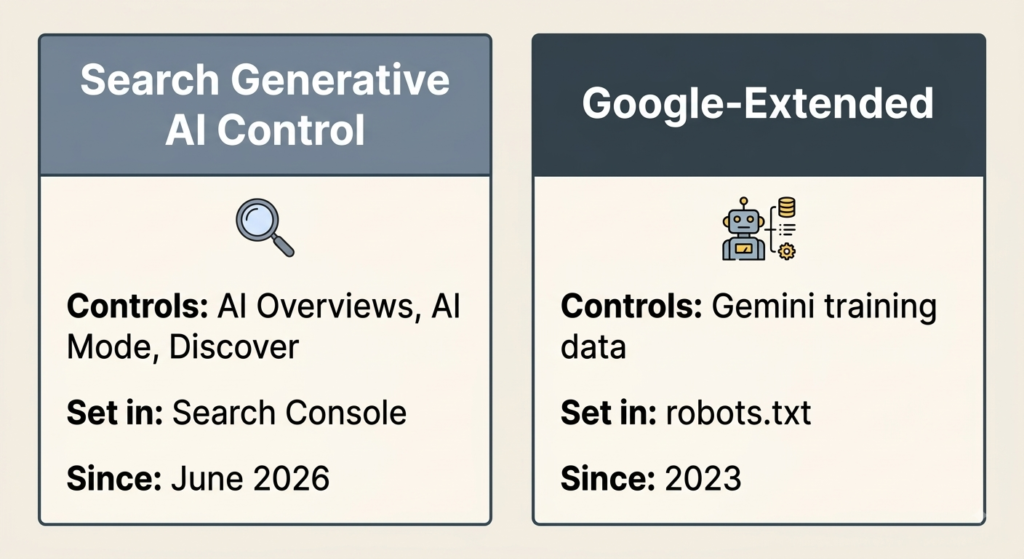
These two get mixed up constantly, and it’s an understandable mix-up — both are Google-built AI controls, and both come with the same reassurance that they won’t touch your Search rankings. But they sit at completely different points in the pipeline.
| Search Generative AI Control | Google-Extended | |
|---|---|---|
| Governs | Whether your content can be retrieved and cited in an AI answer at the moment someone searches | Whether your crawled content can be used to train future Gemini models and ground Gemini Apps / Vertex AI |
| Set where | Search Console → Settings → AI controls → Search generative AI | Your robots.txt file (User-agent: Google-Extended) |
| Options | Include / Exclude / Inherit | Allow / Disallow, standard robots.txt syntax |
| Introduced | June 2026 | September 2023 |
| Affects Search rankings? | No, per Google | No, per Google |
Think of it as a timing difference. AI Overviews and AI Mode work through retrieval-augmented generation — Google’s own generative AI documentation describes this as pulling live pages from the regular Search index the instant someone searches, then writing a response grounded in whatever gets retrieved. Google-Extended never touches that moment at all; it governs something earlier and separate, whether your content becomes training material in the first place. Google’s own materials draw a clean line here: this control has nothing to do with training data. Keeping content out of what trains future Gemini models is a robots.txt job, and that’s Google-Extended’s territory, not this one.
Practically, that means the two settings don’t have to match. Allow Google-Extended while excluding the Search generative AI control, and your content can still train Gemini without ever being cited inside an AI Overview. Reverse it, and your content can be grounded and cited at query time while staying out of training data entirely. Nothing forces these to move together.
Does Opting Out of AI Overviews Hurt Rankings?
Officially, no. Google’s position is that this control has no bearing on ranking or inclusion anywhere else in Search. Your pages stay indexed, stay eligible for ordinary results, and the setting doesn’t reach into Merchant Center or Google Ads participation either — those stay governed by their own switches entirely.
That’s not quite the whole story, though, and it’s the part most coverage skips. Search Engine Journal reported in early August that Top Stories carousels are increasingly showing up embedded inside AI Overviews rather than standing alone as their own feature. Citing tracking firm NewzDash, the report put the rate at roughly one in six US trending-news queries — about 15.5% — where Top Stories appeared nested inside an AI Overview, with a slightly higher figure in the UK at 17.46%. NewzDash’s John Shehata reads that as meaning the opt-out will likely knock publishers out of Top Stories too when it happens to sit inside an AI Overview — though that’s his interpretation of the pattern, not something Google has confirmed. Google’s help documentation doesn’t currently spell out how the control treats a traditional feature that happens to be nested inside a generative one.
There’s also genuine disagreement about whether this remedy does much at all. A paper published this spring in the Journal of European Competition Law and Practice, from Oxford researcher Spencer Cohen and UCL PhD candidate Todd Davies, made the case that mandating an opt-out is a weak fix — their argument being that removing a publisher from AI answers doesn’t hand back whatever traffic or revenue those answers already displaced. Coming from the opposite angle, AI-visibility vendor Noble’s CEO Rahul Jain has argued publicly that opting out does more harm than good for most publishers, since it just pulls you out of a fast-growing surface instead of protecting anything.
Bottom line: for most sites, staying on Include is the low-risk default, and Google’s core claim holds up — this genuinely isn’t a hidden ranking penalty. But if Top Stories placement matters to your business, or your whole model runs on people clicking through instead of reading a summary, this deserves real measurement before you flip the switch, not a shrug.
AI Mode and AI Overviews in Discover: What's Actually Covered
Both the control and the report span three distinct surfaces, and they’re not interchangeable products bundled under one name:
- AI Overviews — the AI-written summary that appears above traditional results for qualifying searches.
- AI Mode — Google’s more conversational, multi-turn search experience, its own dedicated mode within Search.
- Generative AI features in Discover — AI-written summaries surfacing inside the Discover feed, a separate surface from the main results page.
The performance report currently lumps AI Overviews and AI Mode into one combined Search view, with Discover broken out on its own — so there’s no way yet to tell, from the report alone, how much of your visibility is AI Overviews specifically versus AI Mode. The control, by contrast, treats all three as a single package: one Include/Exclude/Inherit decision governs all of them at once. There’s no current way to allow AI Mode while blocking AI Overviews, or the reverse. That kind of surface-by-surface granularity simply isn’t part of the product yet.
Search Generative AI Control US Availability
As of this writing, the control isn’t a default in the US, but it’s stopped being UK-exclusive either and this section may need updating again soon given how fast things are moving.
The actual sequence: Google launched it for a subset of UK site owners only on June 3, 2026, specifically because the CMA’s conduct requirement forced its hand — this wasn’t a global rollout that happened to start in an easy market, it was a legally mandated UK feature that Google then chose to expand outward. By July, the setting had started turning up on accounts outside the UK, including some in the US; Cox Automotive’s Director of Technical SEO, Jamie Indigo, publicly noted spotting it on a US account that month, joking she wasn’t even British and it wasn’t even her birthday. Then, on August 11, reports surfaced of Search Console nudging users toward the performance report with a pop-up seen globally, a sign the reporting half of this launch, specifically, has moved into a much wider phase.
Don’t read “wider” as “everyone has it.” Both pieces are still described as partial rollouts rather than defaults switched on for every property, and the report and the control seem to be expanding on somewhat separate schedules. If Settings doesn’t show it for you yet, that’s the expected state right now, not something broken on your end.
There’s a regulatory clock running underneath all of this too, independent of whatever pace Google sets on its own. Under the CMA’s requirement, Google has to start sharing click-through data by roughly December 2026, and has to deliver page-level controls not just the current property-level switch for generative Search features by March 2027, with compliance reports due to the regulator every six months through year one. Those obligations are UK-specific for now; nothing confirms the same deadlines apply to a US rollout. But they’re a reasonable preview of where the product is headed globally.
Should You Exclude Your Site? A Practical Decision Framework
Don’t touch the toggle until you’ve actually pulled your own Generative AI performance report this isn’t a decision to make on instinct. Once you’ve got real impression numbers in front of you, here’s how to weigh it:
Reasonable candidates for Exclude:
- Sites monetizing content that an AI summary directly substitutes for — proprietary data, paywalled analysis, or research sold as the product itself rather than as a lead magnet
- Publishers already in, or actively negotiating, separate licensing arrangements with AI companies, where diluted exclusivity carries real financial cost
- Anyone who’s pulled the report, seen high AI impressions paired with genuinely flat referral traffic over a meaningful stretch, and made a deliberate call that the exchange isn’t worth it
Usually better off staying on Include:
- Local businesses and service providers, where extra brand exposure is upside with basically no downside
- E-commerce and product pages, where AI Overviews with product links act as one more discovery channel rather than a threat
- Most publishers and bloggers monetizing through ad volume or audience growth stepping away from a channel Google is actively expanding doesn’t recover lost traffic, it just forfeits a growing one
- News publishers leaning on Top Stories exposure, given the still-unresolved overlap described above
- Anyone who hasn’t checked their AI impression numbers yet that’s a “pull the report first” situation, not an “exclude now” one
What This Means for Generative Engine Optimization (GEO)
This launch might be the single most concrete thing to happen to GEO all year, because it turns “optimize for AI visibility” from a vague aspiration into a binary eligibility gate. Google’s own generative AI guide is direct about it: alongside the usual technical Search requirements, a page also has to be included in Search generative AI features in Search Console to even be eligible for generative AI display. Set to Exclude, and none of your GEO effort matters you’re structurally out of the running before content quality ever enters the conversation.
Beyond that eligibility mechanic, Google uses its own guide to knock down a handful of popular GEO tactics it says simply don’t move the needle for Google Search. Creating an llms.txt file does nothing either way for Google specifically, since its systems don’t read them at all — it might still matter for other AI platforms that do, but not this one. Chopping content into small “chunks” for supposed AI comprehension is unnecessary, since Google says its systems already parse multiple topics within a single page without help. Rewriting copy in some special AI-friendly phrasing is similarly pointless, given that Google’s systems are built to understand synonyms and intent rather than exact wording. Chasing inauthentic brand mentions across the web gets waved off too, filed closer to spam than strategy. And piling on structured data specifically for AI purposes doesn’t earn anything extra beyond what it already does for rich results generally.
Google’s underlying position is that optimizing for generative AI search is still just optimizing for the search experience — still SEO, not a separate discipline. What’s genuinely new isn’t a different playbook; it’s that the eligibility switch and the visibility data now both live in Search Console, which makes GEO something you can actually measure there instead of something you inferred from a traffic dip.
Key Takeaways
- Search Generative AI Control is a Search Console setting (Include / Exclude / Inherit) that gates eligibility for AI Overviews, AI Mode, and Discover’s AI features, separately from your regular rankings
- It launched June 3, 2026, took effect June 17, and is still rolling out gradually, UK first, with some US accounts gaining access since July and the report reportedly going global on August 11
- It’s a different lever from Google-Extended entirely: one governs AI training data, the other governs whether you’re cited in an AI answer right now
- Google says it’s not a ranking signal, but Top Stories embedded inside AI Overviews is a real, unconfirmed exception worth watching if you publish news
- The report currently shows impressions only, with no clicks, CTR, or query data yet, though the UK regulator has set a rough timeline for that to change
- Most sites should stay on Include and actually measure AI visibility through the report before ever touching the toggle
Frequently Asked Questions
Does excluding my site from Search generative AI features also remove me from regular Google Search results or Discover?
No. Google says this setting carries no weight as a ranking or inclusion signal anywhere else in Search. Your pages stay indexed and can rank normally — you simply stop being cited, linked, or used to generate answers inside AI Overviews, AI Mode, or Discover’s AI summaries specifically.
If I exclude my site, could I lose visibility somewhere I didn't expect, like Top Stories?
Possibly. Data reported by Search Engine Journal in August 2026 shows Top Stories carousels increasingly rendering inside AI Overviews rather than as their own standalone feature. Since Google hasn’t officially clarified how the control treats a traditional feature nested inside an AI one, publishers who depend on Top Stories should treat this as unresolved rather than settled before opting out.
Is Search Generative AI Control the same thing as Google-Extended?
No. Google-Extended is a robots.txt token controlling whether your crawled content can train future Gemini models. Search Generative AI Control is a separate Search Console setting governing whether your content can be retrieved and cited inside AI Overviews and AI Mode at the moment of a search. The two can be configured completely independently of each other.
Can I exclude just some pages, or is it all-or-nothing?
Property-level only, for now — there’s no way to exclude a single article while leaving the rest of the site included. Under the UK CMA’s compliance timeline, Google is required to introduce page-level controls for generative Search features by March 2027.
Does this setting affect my Merchant Center or Google Ads participation?
No. Those run on their own separate settings entirely; this control doesn’t reach into either one.
Is Search Generative AI Control available in the US yet?
Partially. It launched UK-only on June 3, 2026, under the CMA’s requirement. Some US accounts started seeing the toggle in July 2026, and the companion performance report was reported expanding globally on August 11 — but as of this writing, it’s still described as a partial rollout rather than a default available on every US property.
Will opting out of Google's AI features affect how ChatGPT, Perplexity, or other AI tools cite my site?
No. This setting is specific to Google Search and Discover. Other AI platforms run on their own crawler tokens and opt-outs entirely — OpenAI’s OAI-SearchBot for ChatGPT search visibility, for example, none of which this control touches.
Who can actually change this setting in Search Console?
Based on early access reporting, only users with Owner-level permission on the property can change it. Full and Restricted Users typically see the current value but can’t modify it, consistent with how Google gates its other high-impact Search Console settings.
If I exclude my site, does Google stop using my content entirely?
Not entirely. Google’s documentation notes your content may still help power Search more broadly contributing, for instance, to how its systems understand the language used in queries and across the web generally even while your site stays excluded from generative AI features specifically.